- Product Description Description
- Table of Contents TOC
- List of Table & Figure LOT
- Get Free Sample PDF Sample PDF
Market Size, 2025
$1.85 TnMarket Estimate, 2026
$1.91 TnMarket Forecast, 2034
$2.41 TnCAGR, 2026–2034
3%U.S. Rental Housing Market Size, Growth, Trends & Forecast (2026–2034)
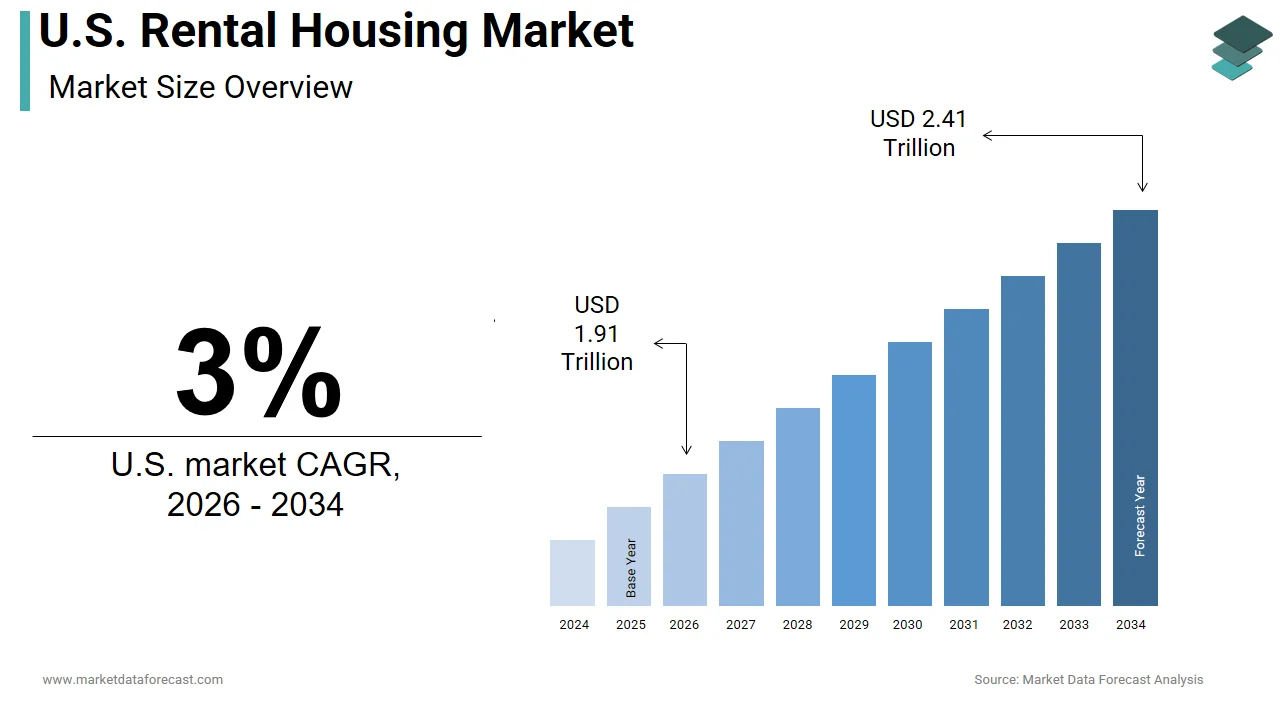
The U.S. rental housing market was valued at USD 1.85 trillion in 2025, is estimated to reach USD 1.91 trillion in 2026, and is projected to expand up to USD 2.41 trillion by 2034, growing at a compound annual growth rate (CAGR) of 3.00% from 2026 to 2034. Driven by high mortgage rates constraining homeownership and long-term structural shifts toward renting among millennials and single-person households, the market serves as a critical pillar of residential stability.
Key Executive Metrics (At-a-Glance)
- 2025 Base Valuation: USD 1.85 Trillion
- 2026 Current Valuation: USD 1.91 Trillion
- 2034 Forecast Valuation: USD 2.41 Trillion
- Compound Annual Growth Rate (CAGR): 3.00% (2026–2034)
- Dominant Type Segment: Long-Term Rentals
- Fastest-Growing Type Segment: Short-Term Rentals (13.1% CAGR)
- Dominant Property Type: Apartments (~60% inventory share)
- Fastest-Growing Property Type: Single-Family Houses (15.4% CAGR)
- Dominant End User: Residential End-User
- Fastest-Growing End User: Commercial End-User (10.7% CAGR)
Core Market Drivers
- Demographic Urbanization & Millennial Demand: Continuous migration to cities and delayed homeownership expanding the core tenant pool.
- High Mortgage Rates & Home Prices: Soaring borrowing costs and record home values pricing out prospective buyers, keeping them in rentals.
- Technology Integration & Build-to-Rent: Smart home feature adoption and purpose-built single-family rental communities driving institutional investment.
Primary Market Restraints & Challenges
- Zoning Restrictions & Supply Bottlenecks: Stringent local land-use laws and permitting delays constraining new multifamily development.
- Affordability Crisis & Cost Pressures: Rents outpacing wage growth, creating heavy cost burdens for low- to moderate-income renters.
- Regulatory Uncertainty: Rent control proposals and strict tenant protection laws impacting investor confidence and long-term planning.
U.S. Rental Housing Market Segmentation Breakdown
| Segment Category | Leading Sub-Segment (2025 Base) | Fastest-Growing Sub-Segment (Forecast Period) |
|---|---|---|
| By Type | Long-Term Rentals (Backbone of housing stability; 12+ month leases) | Short-Term Rentals (CAGR of 13.1%; fueled by experiential travel & digital platforms) |
| By Property Type | Apartments (Multifamily units accounting for ~60% of rental housing inventory) | Single-Family Houses (CAGR of 15.4%; driven by suburban migration and remote work) |
| By End User | Residential End-User (Over 44.5 million households relying on primary housing leases) | Commercial End-User (CAGR of 10.7%; agile corporate housing and hybrid work spaces) |
Major Industry Players Profiled
Leading organizations and real estate investment trusts (REITs) steering the landscape include Equity Residential, AvalonBay Communities Inc., Invitation Homes Inc., alongside prominent digital platforms and operators like Airbnb, Zillow, Vrbo, and Apartments.com.
U.S. Rental Housing Market Size
The U.S. rental housing market was valued at USD 1.85 trillion in 2025 and is estimated to reach USD 1.91 trillion in 2026, and is projected to reach USD 2.41 trillion by 2034, growing at a CAGR of 3% from 2026 to 2034.
Rental housing constitutes a critical segment of the national residential real estate landscape, encompassing single-family homes, multifamily apartments, and condominiums leased to tenants. This sector serves as a primary housing solution for a diverse demographic, including young professionals, students, and families who prioritize flexibility or lack the financial capacity for homeownership. The market dynamics are heavily influenced by macroeconomic factors, such as employment rates, wage growth, and mortgage interest rates. According to the U.S. Census Bureau, approximately 32.2% of all occupied housing units in the country were renter-occupied in the fourth quarter of 2023, which reflects a substantial portion of the population relying on leased accommodations. Furthermore, according to the Joint Center for Housing Studies of Harvard University, the number of renter households has increased by nearly 10 million over the past two decades, demonstrating a long-term structural shift toward renting. High home prices and limited inventory have further constrained ownership opportunities, pushing more individuals into the rental pool. As per the Federal Reserve Bank of Atlanta, median home prices in many metropolitan areas remain significantly higher than historical averages relative to income. This affordability gap sustains robust demand for rental properties across various price points. Landlords and property management firms operate within this environment, balancing occupancy rates with maintenance costs and regulatory compliance. The integration of technology in property management has streamlined operations, enhancing tenant experiences. These elements collectively define a market that is essential for housing stability and economic mobility, while facing ongoing pressures from supply constraints and evolving consumer preferences.
MARKET DRIVERS
Demographic Shifts toward Urbanization and Millennial Household Formation Drive Demand
The continuous migration of populations toward urban centers and the rapid formation of millennial households are propelling the expansion of the U.S. rental housing market. Young adults, particularly those aged 25 to 34, are increasingly choosing to live in cities where job opportunities and social amenities are concentrated. According to the U.S. Census Bureau, Millennials now constitute the largest generation in the workforce, with over 72 million individuals contributing to economic activity. This demographic cohort exhibits a strong preference for renting due to lifestyle flexibility and the desire to avoid the long-term commitment of homeownership. Data from the National Association of Realtors shows that the median age of first-time homebuyers has risen to 36 years, indicating a delayed transition to ownership. Consequently, many young professionals remain in the rental market for extended periods, driving up demand for urban apartments and suburban rentals. Furthermore, the increase in single-person households has amplified the need for smaller rental units. According to the U.S. Census Bureau, the share of single-person households reached 29% in 2023, creating a steady stream of tenants seeking one-bedroom or studio apartments. Urbanization trends also mean that renters prioritize proximity to public transportation and entertainment venues, which are abundant in city centers. This concentration of demand in metropolitan areas ensures high occupancy rates and supports rental price growth. The combination of delayed homeownership and urban preference creates a resilient and expanding tenant base that sustains the vitality of the rental housing sector.
High Mortgage Interest Rates and Home Prices Constrain Homeownership Accessibility
The elevated mortgage interest rates and soaring home prices are further boosting the U.S. rental housing market expansion. When the cost of borrowing increases, monthly mortgage payments become prohibitive for many potential buyers, forcing them to remain in the rental market. According to the Federal Reserve, the average rate for a 30-year fixed mortgage reached 7.79% in October 2023, the highest level in over two decades. This sharp increase in financing costs has drastically reduced purchasing power for prospective homebuyers. Data from the National Association of Home Builders indicates that a rise in mortgage rates from 3% to 7% reduces the maximum loan amount a buyer can qualify for by approximately 30%. Consequently, many individuals who would otherwise purchase homes are compelled to continue renting. Furthermore, median home prices in major markets remain near record highs, exacerbating the affordability crisis. According to Zillow, the typical home value in the U.S. reached $348,000 by the end of 2023, requiring substantial down payments that many savers cannot accumulate. The combination of high entry costs and expensive debt creates a barrier that keeps millions of households in the rental pool. This dynamic ensures a consistent and growing demand for rental properties, as consumers wait for more favorable market conditions. The prolonged period of unaffordability solidifies renting as a necessary long-term housing strategy for many Americans.
MARKET RESTRAINTS
Strict Zoning Laws and Land Use Regulations Restrict New Housing Supply
Stringent zoning laws and complex land use regulations are impeding the growth of the U.S. rental housing market. Local governments often impose restrictions on density, height, and building types, which hinder the development of multifamily properties needed to meet growing demand. According to the Urban Institute, restrictive zoning practices in high-demand metropolitan areas have significantly reduced housing supply compared to regions with flexible regulations. These constraints lead to shortages that drive up rental prices and reduce availability for tenants. Data from the National Multifamily Housing Council shows that permitting delays can add six to twelve months to project timelines, increasing development costs and discouraging investment. As per the Brookings Institution, exclusionary zoning policies that mandate single-family detached homes prevent the construction of affordable apartment complexes in desirable neighbourhoods. This lack of supply elasticity means that the market cannot quickly respond to increases in demand, resulting in persistent vacancies and higher rents. Furthermore, environmental review processes and community opposition often stall or cancel proposed developments. The scarcity of buildable land in urban cores further exacerbates the issue, forcing developers to seek locations farther from city centers. These regulatory barriers create a structural imbalance between supply and demand that constrains market growth and limits housing options for lower and middle-income renters. Until zoning reforms are implemented, the supply side will remain a significant bottleneck for the rental housing sector.
Rising Construction Costs and Labor Shortages Impede Development Projects
The growing construction costs and a persistent shortage of skilled labor are further hindering the expansion of the U.S. rental housing market. The cost of building materials, such as lumber, steel, and concrete, has fluctuated wildly due to supply chain disruptions and inflationary pressures. According to the U.S. Bureau of Labor Statistics, the Producer Price Index for inputs to residential construction increased by 15% between 2021 and 2023, which is raising the overall expense of new projects. These higher costs make it difficult for developers to achieve viable returns on investment, particularly for affordable housing units. According to the data from the Bureau of Labor Statistics, the construction industry faces a significant deficit of workers, leading to project delays and increased wage expenses. As per the National Association of Home Builders, labor shortages have caused nearly 90% of builders to report longer completion times for new structures. The combination of expensive materials and scarce labor forces developers to postpone or cancel planned rental communities. This reduction in new supply exacerbates existing housing shortages and puts upward pressure on rents for existing units. Furthermore, higher interest rates on construction loans add to the financial burden, which is making financing more expensive. The inability to bring new units to market efficiently limits the ability of the rental sector to accommodate growing demand. Consequently, these economic and operational challenges restrain market expansion and contribute to the ongoing affordability crisis for renters across the country.
MARKET OPPORTUNITIES
Integration of Smart Home Technology Enhances Tenant Attraction and Retention
The integration of smart home technology is a potential opportunity for the U.S. rental housing market by enhancing property appeal and improving operational efficiency for landlords. Modern tenants increasingly seek residences equipped with connected devices, such as smart thermostats, keyless entry systems, and energy monitoring tools. According to the National Apartment Association, approximately 62% of renters are willing to pay more for smart home features, citing convenience and security as primary benefits. Landlords who invest in these technologies can command higher rental premiums and reduce vacancy rates. Data from Deloitte indicates that smart home-enabled units experience 10% lower turnover rates compared to traditional units, as tenants value the enhanced living experience. Furthermore, smart meters and leak detectors allow property managers to monitor utility usage and detect maintenance issues proactively, reducing repair costs. As per the Internet of Things Consortium, the adoption of connected devices in multifamily buildings is projected to grow by 20% annually, driven by tenant demand and operational savings. Energy-efficient smart systems also align with sustainability goals, attracting environmentally conscious renters. The ability to offer remote management capabilities, such as virtual tours and online lease signing, further streamlines the leasing process. By leveraging technology, property owners can differentiate their offerings in a competitive market. This technological evolution creates new revenue streams and improves asset value, positioning the rental housing sector for modernization and growth.
Expansion of Build to Rent Communities Offers Specialized Investment Avenues
The emergence of build-to-rent communities is another substantial opportunity for the U.S. rental housing market by providing institutional investors with scalable and standardized rental products. These purpose-built single-family rental developments are designed specifically for long-term leasing rather than sale, offering a unique value proposition for families seeking space and stability. According to the National Association of Home Builders, build-to-rent construction starts reached a record 69,000 units in 2023, reflecting growing developer interest in this sector. Institutional investors are attracted to the predictable cash flows and lower management intensity compared to scattered single-family rentals. Data from RealPage shows that build-to-rent communities achieve occupancy rates exceeding 95% due to high demand from renters who desire suburban lifestyles without homeownership responsibilities. These communities often include amenities, such as pools, fitness centers, and playgrounds, which enhance tenant satisfaction. As per Morgan Stanley, the build-to-rent sector is expected to account for 10% of all new single-family construction in the coming years. This trend allows landlords to benefit from economies of scale in maintenance and marketing. Furthermore, the demographic shift toward suburban living post-pandemic has fueled demand for these types of properties. By focusing on this niche market, investors can capture a growing segment of renters who prioritize space and community. This expansion diversifies the rental housing landscape and provides new avenues for capital deployment.
MARKET CHALLENGES
Affordability Crisis Limits Access For Low and Moderate-Income Tenants
The escalating affordability crisis is a significant challenge to the expansion of the U.S. rental housing market. Rental prices have outpaced wage growth in many regions, creating a severe burden for households with limited financial resources. According to the National Low Income Housing Coalition, there is a shortage of 7.3 million affordable and available rental homes for extremely low-income renters in the U.S. This deficit forces many families to spend more than 50% of their income on rent, leaving little for other essential needs. According to the Joint Center for Housing Studies of Harvard University, a record 22.4 million renter households were cost-burdened in 2022, the highest level ever recorded. As per the Department of Housing and Urban Development, fair market rents have increased by 10% annually in many metropolitan areas, while median incomes have grown at a slower pace. The lack of subsidized housing options exacerbates the problem, leaving vulnerable populations at risk of homelessness. Landlords face difficulties in balancing profitability with social responsibility as operating costs rise. The widening gap between income and rent creates social instability and reduces economic mobility for renters. Without significant policy interventions or an increased supply of affordable units, this challenge will persist, undermining the inclusivity and sustainability of the rental housing market.
Regulatory Uncertainties and Rent Control Measures Impact Investor Confidence
Regulatory uncertainties and the implementation of rent control measures are further challenging the U.S. rental housing market growth. Several states and municipalities have introduced or considered legislation that limits rental price increases and imposes stricter eviction protocols. According to the National Conference of State Legislatures, over 20 states have debated rent stabilization bills in recent years, causing concern among property owners. These regulations can reduce the potential return on investment and discourage new development in affected areas. Data from the Urban Institute suggests that strict rent control policies may lead to a decline in the quality of existing housing stock, as landlords defer maintenance to offset revenue losses. As per the American Apartment Owners Association, legal challenges and compliance costs associated with new tenant protection laws increase operational burdens for property managers. The fear of retroactive regulations or sudden policy changes makes long-term planning difficult for investors. Furthermore, varying local laws create a fragmented regulatory landscape that complicates portfolio management for national operators. This uncertainty can lead to reduced capital inflows into the rental sector, limiting the funds available for improvements and new construction. Consequently, the regulatory environment acts as a deterrent to investment, potentially exacerbating supply shortages and hindering the market's ability to meet housing needs effectively.
REPORT COVERAGE
| REPORT METRIC | DETAILS |
| Market Size Available | 2025 to 2034 |
| Base Year | 2025 |
| Forecast Period | 2026 to 2034 |
| Segments Covered | By Type, Property Type, End User, Platform, and Country. |
| Various Analyses Covered | Global, Regional, and Country-Level Analysis, Segment-Level Analysis, Drivers, Restraints, Opportunities, Challenges; PESTLE Analysis; Porter’s Five Forces Analysis, Competitive Landscape, Analyst Overview of Investment Opportunities |
| Countries Covered | New York, Massachusetts, Pennsylvania, Illinois, Ohio, Michigan, Texas, Florida, Georgia, California, Washington, Colorado. |
| Market Leaders Profiled | Airbnb, Booking.com, Expedia Group, Equity Residential, Zillow, Trulia, Vrbo, HomeAway, Apartments.com, RentPath, Redfin, Realtor.com, OYO Rooms, Nestpick, Spotahome, FlipKey, Homestay.com, AvalonBay Communities Inc, Invitation Homes Inc, HousingAnywhere, 9flats, Roomster, Wimdu. |
SEGMENTAL ANALYSIS
By Type Insights
The long-term rentals segment accounted for the largest share of the U.S. rental housing market in 2025. The growth of the long-term rentals segment in the U.S. market can be credited to the fundamental need for stable and affordable housing among the majority of the population. This segment encompasses leases typically lasting twelve months or longer and serves as the primary residence for millions of Americans. The structural shift toward renting due to high homeownership barriers is further propelling the dominance of the long-term rentals segment in the U.S. market. According to the U.S. Census Bureau, approximately 35% of all households are renter-occupied, with the vast majority holding long-term leases that provide housing stability. Data from the Joint Center for Housing Studies of Harvard University indicates that long-term renters account for over 44 million households, reflecting a deep-seated reliance on this housing model. The predictability of monthly housing costs allows tenants to budget effectively, which is crucial in an inflationary economic environment. As per the National Apartment Association, long-term leases reduce turnover costs for property owners, ensuring steady cash flow and lower vacancy rates compared to short-term alternatives. Furthermore, zoning laws in most residential areas prioritize long-term occupancy, limiting the feasibility of short-term rentals in many communities. The demand for family-friendly environments with access to schools and local amenities also favors long-term arrangements. These factors collectively establish long-term rentals as the backbone of the US housing market, sustaining high occupancy and consistent revenue streams for investors and landlords across the country.

However, the short-term rentals segment is expected to expand at a promising CAGR of 13.1% during the forecast period in the U.S. market, owing to the increasing popularity of experiential travel and the flexibility offered by digital platforms that connect hosts with guests, and the changing consumer preference for unique and localized accommodation experiences over traditional hotels. According to AirDNA, active short-term rental listings in the U.S. reached 1.56 million in 2023, reflecting strong host participation and guest demand. Data from the U.S. Travel Association shows that domestic leisure travel has rebounded significantly, with travelers seeking private spaces that offer kitchen facilities and multiple bedrooms. The ability for property owners to generate higher yields per night, compared to long-term leases, incentivizes the conversion of units into short-term rentals. As per McKinsey, the short-term rental market is expected to capture a larger share of the lodging industry, particularly in urban and vacation destinations. Furthermore, the rise of remote work has enabled digital nomads to extend their stays, blurring the lines between tourism and temporary housing. This trend increases the average length of stay and stabilizes revenue for hosts. The integration of professional management services also lowers the barrier to entry for new hosts. These dynamics position short-term rentals as a high-velocity segment that continues to disrupt traditional hospitality models.
By Property Type Insights
The apartments segment led the market by commanding for the leading share of the U.S. market in 2025. The growth of the apartments segment in the U.S. market is driven by their prevalence in urban areas and their appeal to a wide demographic of renters. This property type includes multifamily buildings ranging from low-rise walk-ups to high-rise luxury towers. According to the National Multifamily Housing Council, there are over 40 million apartment units in the U.S., representing the largest inventory of rental housing. As per the data from the U.S. Census Bureau, apartments account for nearly 60% of all rental units, highlighting their central role in the housing ecosystem. The convenience of located amenities, such as fitness centers, pools, and maintenance services, attracts young professionals and students who value hassle-free living. As per the Urban Land Institute, apartment developments in transit-oriented locations experience higher occupancy rates due to reduced transportation costs for residents. Furthermore, the scalability of apartment management allows institutional investors to operate efficiently, achieving economies of scale in maintenance and marketing. The diversity of unit sizes, from studios to three-bedroom layouts, accommodates various household types, including singles, couples, and small families. These factors collectively ensure that apartments remain the most accessible and widely utilized form of rental housing, sustaining their leadership in the market.
On the other hand, the single-family houses segment is predicted to register a promising CAGR of 15.4% during the forecast period in the U.S. market, owing to the demographic shift toward suburban living, accelerated by the adoption of remote work policies. According to the National Association of Home Builders, single-family built-for-rent starts increased by 18% in 2023, as developers respond to tenant preferences for yards and home offices. Data from RealPage indicates that single-family rentals achieve higher retention rates than apartments, as tenants tend to stay longer due to the stability and community feel of neighborhoods. As per Zillow, the search volume for single-family rentals has grown by 25% year-over year, reflecting intense interest from families and individuals seeking more living space. The ability to accommodate pets and provide outdoor areas further enhances the appeal of these properties. Institutional investors are increasingly entering this space through build-to-rent communities, which offer professional management and standardized quality. This trend professionalizes the sector and increases the supply of high-quality homes for rent. The combination of lifestyle preferences and investor interest positions single-family houses as the most dynamic and rapidly expanding property type in the rental market.
By End User Insights
The residential end-user segment dominated the market with the leading share of the U.S. rental housing market in 2025. The dominance of the residential segment in the U.S. market can be credited to the sheer volume of renters who rely on the market for primary accommodation. According to the U.S. Census Bureau, approximately 44.5 million households are renter-occupied, representing a substantial portion of the population. Data from the Joint Center for Housing Studies of Harvard University indicates that residential renters span all age groups, income levels, and geographic regions, creating a broad and stable demand base. The inability of many households to afford homeownership due to high prices and strict lending standards ensures a continuous flow of tenants into the residential rental market. As per the National Low Income Housing Coalition, the majority of extremely low-income renters depend entirely on the private residential rental sector for housing. Furthermore, the flexibility of renting appeals to mobile workers and students who require temporary housing solutions. The residential segment also benefits from government programs, such as Section 8 vouchers, which subsidize rents for eligible tenants. These factors collectively establish residential users as the core of the rental housing market, driving consistent occupancy and revenue for landlords and property management firms across the nation.
On the other side, the commercial end-user segment is anticipated to record a CAGR of 10.7% during the forecast period in the U.S. market, owing to the evolution of work patterns where companies seek agile real estate solutions to support hybrid work models. According to the International Workplace Group, the demand for flexible office space has increased by 30%, as businesses reduce their long-term lease commitments. Data from CBRE shows that corporate housing rentals have risen by 15% annually, as companies relocate talent and manage project-based staffing needs. The rise of the gig economy also contributes to this trend, with independent contractors requiring short-term furnished accommodations. According to the Global Business Travel Association, corporate travel spending reached $1.3 trillion in 2023, leading to higher demand for extended stay rentals in major business hubs. Furthermore, the integration of technology in commercial rentals, such as smart access and high-speed internet, enhances their appeal to modern businesses. The ability to scale space up or down quickly provides cost efficiency for companies navigating economic uncertainty. These dynamics position the commercial segment as a high-growth area that complements the traditional residential market.
COUNTRY ANALYSIS
U.S. Rental Housing Market Analysis
The United States is likely to see its rental market evolve toward more institutional ownership and technology-driven management for the next few years. The U.S. stood as the largest and most mature rental housing market globally in 2025 due to the large and diverse population, robust legal frameworks for landlord-tenant relationships, and a well-developed financial system that supports real estate investment. The market status in the region is characterized by high levels of institutional participation and sophisticated property management practices. A primary driving factor for this leadership is the significant barrier to homeownership, created by high property prices and elevated mortgage interest rates. According to the Federal Reserve Bank of Atlanta, housing affordability reached its lowest level in over 30 years in 2023, forcing many households to remain in the rental market for extended periods. Data from the U.S. Census Bureau shows that the rental vacancy rate remains low at around 6.6%, indicating tight supply and strong demand. Furthermore, the presence of major real estate investment trusts and private equity firms provides ample capital for the development and acquisition of rental properties. As per the National Multifamily Housing Council, institutional investors own a growing share of multifamily assets, enhancing the professionalism and efficiency of the market. The cultural acceptance of renting as a long-term housing strategy also supports market stability. Additionally, government policies, such as tax incentives for depreciation, encourage investment in rental housing. These structural and economic factors solidify the U.S. as the central hub of global rental housing activity.
COMPETITIVE LANDSCAPE
The competition in the U.S. rental housing market is intense and characterized by a mix of large institutional real estate investment trusts, regional operators, and individual landlords. Major players compete based on property quality, location amenities, and customer service excellence. Institutional owners leverage economies of scale to offer standardized services and advanced technology platforms that enhance the tenant experience. Regional operators differentiate themselves through local market expertise and personalized community engagement. The rise of single-family rental providers has added a new dimension to competition by offering suburban alternatives to urban apartments. Price competitiveness remains important, but value-added services such as smart home features and flexible lease terms increasingly influence tenant decisions. High barriers to entry in prime locations protect established players from new competitors; however, rising construction costs and labor shortages challenge all market participants. Regulatory variations across states and municipalities add complexity to operations requiring adaptive compliance strategies. Ultimately, success depends on the ability to maintain high occupancy rates, control operating expenses, and deliver superior living experiences that meet the evolving needs of a diverse renter demographic in a tightly constrained supply environment.
KEY MARKET PLAYERS
Some of the companies that are playing a dominating role in the U.S. rental housing market include
- Airbnb
- com
- Expedia Group
- Equity Residential
- Zillow
- Trulia
- Vrbo
- HomeAway
- com
- RentPath
- Redfin
- com
- OYO Rooms
- Nestpick
- Spotahome
- FlipKey
- com
- AvalonBay Communities Inc.
- Invitation Homes Inc.
- HousingAnywhere
- 9flats
- Roomster
- Wimdu
TOP PLAYERS IN THE US MARKET
- Equity Residential is a prominent real estate investment trust that specializes in the acquisition, development, and management of high-quality apartment communities in the U.S.. The company focuses on major metropolitan areas with strong job growth and demographic trends that support rental demand. Recent actions to strengthen its market position include strategic investments in smart home technology to enhance resident experience and operational efficiency. Equity Residential has also prioritized sustainability initiatives by implementing energy-efficient upgrades across its portfolio. The company leverages data analytics to optimize pricing strategies and improve occupancy rates. By maintaining a diverse geographic footprint and focusing on customer service excellence, Equity Residential ensures stable revenue streams. These efforts reinforce its reputation as a leading provider of modern living spaces and contribute significantly to the stability and growth of the urban rental housing sector.
- AvalonBay Communities Inc is a leading equity real estate investment trust engaged in the development, redevelopment, acquisition, and management of multifamily properties. The company operates primarily in high-barrier-to-entry markets along the East and West coasts where supply constraints support strong rental performance. Recent actions to strengthen its market position include expanding its digital leasing platforms to streamline the tenant onboarding process. AvalonBay has also increased its focus on environmental, social, and governance criteria by pursuing green building certifications. The company actively manages its portfolio through asset repositioning and value-add renovations to meet evolving consumer preferences. By leveraging its extensive market knowledge and operational expertise, AvalonBay delivers consistent returns to shareholders. Its commitment to innovation and community building enhances tenant retention and solidifies its role as a key player in the competitive US rental housing landscape.
- Invitation Homes Inc is the largest owner-operator of single-family homes for lease in the U.S., providing a unique alternative to traditional apartment living. The company offers well-maintained homes in desirable suburban neighborhoods, catering to families and individuals seeking more space and privacy. Recent actions to strengthen its market position include utilizing advanced technology for predictive maintenance and personalized customer service. Invitation Homes has expanded its portfolio through strategic acquisitions and new construction partnerships to meet growing demand. The company focuses on professionalizing the single-family rental sector by standardizing leasing processes and improving home quality. By offering a seamless digital experience and reliable property management, Invitation Homes attracts long-term tenants. Its scale and operational efficiency allow it to provide consistent housing options across multiple states. These initiatives drive growth and establish the company as a dominant force in the evolving single-family rental market segment.
TOP STRATEGIES USED BY KEY MARKET PARTICIPANTS
Key players in the U.S. rental housing market primarily employ technological integration and portfolio optimization to maintain competitive advantages. Companies invest heavily in property management software to automate leasing processes and enhance tenant engagement. This digital transformation improves operational efficiency and reduces administrative costs significantly. Strategic acquisitions of high-quality assets in growing markets allow firms to expand their geographic footprint and diversify risk. Operators also focus on sustainability initiatives, such as energy-efficient upgrades to attract environmentally conscious renters and reduce utility expenses. Customer experience enhancement through responsive maintenance and community-building activities drives higher retention rates. Additionally, firms leverage data analytics to optimize rental pricing and forecast market trends accurately. These multifaceted strategies enable participants to adapt to changing consumer preferences and economic conditions while maximizing asset value and ensuring long-term profitability in a dynamic residential real estate environment.
MARKET SEGMENTATION
This research report on the U.S. rental housing market has been segmented and sub-segmented into the following categories.
By Type
- Short-Term Rentals
- Long-Term Rentals
By Property Type
- Apartments
- Houses
- Condominiums
- Townhouses
- Others
By End User
- Residential
- Commercial
By Platform
- Online
- Offline
By Country
- New York
- Texas
- Florida
- Georgia
- California
- Rest of U.S.