- Product Description Description
- Table of Contents TOC
- List of Table & Figure LOT
- Get Free Sample PDF Sample PDF
Market Size, 2025
$71.99 BnMarket Estimate, 2026
$76.60 BnMarket Forecast, 2034
$125.82 BnCAGR, 2026–2034
6.4%Executive Summary: U.S. Auto Finance Market
- Market Scope: Comprehensive analysis of the United States auto finance sector, detailing installment loans, lease agreements, captive finance structures, and digital lending platforms.
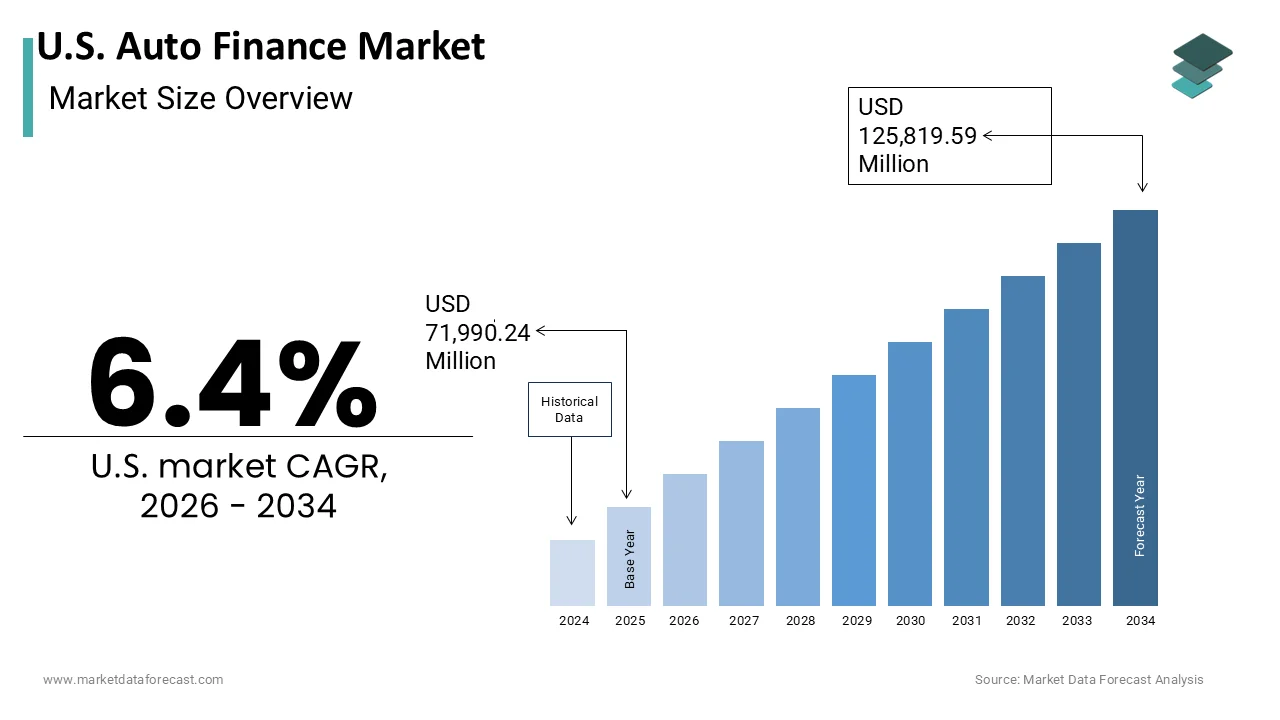
- Market Valuation: Valued at USD 71,990.24 million in 2025, reaching USD 76,597.62 million in 2026, and projected to expand to USD 125,819.59 million by 2034, growing at a steady CAGR of 6.4% from 2026 to 2034.
- Primary Growth Drivers: Sustained personal mobility needs driven by suburban sprawl and technological advancements in automated credit underwriting and risk assessment.
Key Market Segment Metrics
| Category | Leading Segment (Base Position) | Fastest-Growing / High-Growth Segment |
|---|---|---|
| By Provider Type | Banks Segment (held 44.3% market share in 2025, backed by extensive capital reserves, low-cost deposits, and cross-selling capabilities) | Original Equipment Manufacturers (OEMs) / Captive Finance (projected at a 5.8% CAGR, fueled by subvented lease programs and incentive packages) |
| By Finance Type | Indirect Financing (held 22.3% market share in 2025, acting as a one-stop dealership shop for comparing multi-lender credit offers) | Direct Lending (projected at a 6.5% CAGR, propelled by digital-native lenders and fintech platforms offering pre-approvals) |
| By Vehicle Type | Passenger Vehicles (occupied dominant share in 2025, driven by stable household replacement cycles and personal mobility necessities) | Commercial Vehicles (projected at a rapid 7.2% CAGR, driven by e-commerce expansion, last-mile logistics, and fleet financing) |
| By Country / Region | California & Texas (major automotive and financing hubs with dense personal and commercial vehicle markets) | Florida & New York (high-growth urban and suburban markets adopting digital fintech lending and EV lease options) |
Major Market Players & Industry Landscape
Market Structure: Highly competitive landscape comprising national banking institutions, captive automotive finance arms, credit unions, and disruptive fintech lenders competing on digital convenience and interest rates.
Key Companies: Ally Financial Inc., Capital One Financial Corporation, Ford Motor Credit Company LLC, Toyota Financial Services, GM Financial Inc., Wells Fargo & Company, Bank of America Corporation, JPMorgan Chase & Co., Santander Consumer USA Holdings Inc., TD Auto Finance, Huntington Bancshares Incorporated, and Credit Acceptance Corporation.
 Download Free Sample Report
U.S. Auto Finance Market Size
The U.S. Auto Finance Market is projected to grow from USD 71,990.24 million in 2025 to USD 76,597.62 million in 2026 and reach USD 125,819.59 million by 2034, registering a CAGR of 6.4% during the forecast period from 2026 to 2034.
The auto finance is a specialized financial ecosystem dedicated to facilitating the acquisition of motor vehicles through credit instruments, such as installment loans and lease agreements. The diverse array of lending entities, including captive finance arms, commercial banks,s credit unions, ns and independent finance companies that compete on interest rates,ates approval speed, and customer service quality. Furthermore, the Department of Labor states that the average hourly earnings increased by 4.1% year over year in early 2024, which influences consumer borrowing capacity and repayment confidence. The transition toward electrification introduces new valuation dynamics for lenders who must assess battery longevity and technological obsolescence risks. Regulatory frameworks enforced by the Consumer Financial Protection Bureau ensure transparent lending practices and protect borrowers from predatory terms. Digital transformation has reshaped the origination process with online platforms offering instant pre-approvals and streamlined documentation. This market operates within a macroeconomic environment where inflation and monetary policy shifts directly impact borrowing costs and consumer sentiment. Lenders increasingly utilize advanced analytics to refine risk assessment models, ensuring portfolio stability amidst economic volatility.
MARKET DRIVERS
Sustained Demand for Personal Mobility in Suburban Infrastructure
The structural dependence on personal vehicles by suburban sprawl and limited public transportation infrastructure is greatly influencing the growth of the United States auto finance market. Most American households require at least one vehicle for daily commuting, shopping, and social activities,s making auto loans a necessity rather than a discretionary expense. This reality ensures a steady baseline demand for financing regardless of short-term economic fluctuations. As urban centers expand outward into suburban areas, the distance between residential zones and commercial hubs increases,ases necessitating reliable personal transport. Lenders capitalize on this inelastic demand by offering flexible loan terms that accommodate various income levels. This multi-vehicle ownership pattern amplifies the volume of loans originated within the market.
Technological Advancements in Credit Underwriting and Risk Assessment
Technological advancements in credit underwriting and risk assessment have significantly expanded the reach and efficiency by enabling more accurate and inclusive lending decisions. The technological advancements in credit underwriting and risk assessment are also boosting the growth of the United States auto finance market. Financial institutions now leverage artificial intelligence machine learning and alternative data sources to evaluate borrower creditworthiness beyond traditional FICO scores. The integration of automated decisioning systems reduces loan approval times from days to minutes, enhancing the customer experience and increasing conversion rates. These efficiencies lower operational costs and allow lenders to offer competitive interest rates. Furthermore, predictive analytics help institutions identify potential default risks earlier,r allowing for proactive mitigation strategies. The ability to personalize loan offers based on real-time data insights strengthens customer relationships and drives loyalty.
MARKET RESTRAINTS
Affordability Constraints Due to Elevated Vehicle Prices
The elevated vehicle prices by stretching consumer budgets and limiting the pool of qualified borrowers are a major factor hindering the growth of the United States auto finance market. The average transaction price for new vehicles has remained historically high due to persistent supply chain issues and increased manufacturing costs. This price escalation forces consumers to take out larger loans with longer repayment terms, which increases their total interest burden and financial vulnerability. Many buyers are pushed into subprime categories, as they struggle to qualify for prime rates with higher loan amounts. The debt-to-income ratios for auto borrowers have risen, indicating reduced financial flexibility. Additionally, high prices discourage trade-ins as owners hold onto older vehicles longer, reducing the supply of used cars and keeping those prices elevated as well. Lenders face higher default risks as borrowers struggle to manage payments alongside other rising living expenses.
Tightening Lending Standards Amidst Economic Uncertainty
The tightening of lending standards amidst economic uncertainty by restricting credit access for marginal borrowers is additionally impeding the growth of the United States auto finance market. Financial institutions have become more cautious in their approval processes due to fears of rising delinquencies and potential economic downturns. This contraction in credit availability reduces the number of approved applications and slows market activity. Lenders are raising minimum credit score requirements and demanding larger down payments to mitigate risk exposure. The banks have increased provisions for credit losses in their auto portfolios, reflecting heightened caution. Subprime borrowers are particularly affected as lenders retreat from higher-risk segments to protect profitability. Additionally, stricter verification of income and employment status prolongs the approval process, causing friction for customers. The compliance costs associated with rigorous underwriting have increased operational burdens for lenders. This conservative approach limits market expansion and excludes potential customers who might otherwise contribute to loan growth.
MARKET OPPORTUNITIES
Expansion of Subscription-Based Mobility Services
The emergence of subscription-based mobility services by creating new revenue streams and flexible ownership models is certainly to create new opportunities for the growth of the United States auto finance market. Automakers and third-party providers are launching vehicle subscription programs that bundle insurance, maintenance,e and financing into a single monthly fee. Finance companies can partner with these providers to offer wholesale flooring for subscription fleets and retail financing for individual subscribers. This model appeals to younger demographics who prioritize access over ownership and value the ability to switch vehicles frequently. Lenders can leverage data from these platforms to better understand usage patterns and tailor financial products accordingly. Additionally, subscription services reduce the residual value risk for lenders by keeping vehicles within managed fleets where maintenance is strictly controlled. The National Automobile Dealers Association highlights that dealerships adopting subscription models report higher customer retention rates. By integrating financing into these holistic mobility solutions, nNSlenders can differentiate themselves in a crowded market. This shift also opens opportunities for bundling ancillary products such as roadside assistance and connectivity packages.
Integration of Blockchain for Transparent Title Management
The integration of blockchain technology for transparent title management by enhancing security and efficiency in lien processing is another factor promoting the growth of the United States auto finance market. Traditional title workflows are often plagued by delays, ays fraud, and administrative errors,s which increase costs for lenders and borrowers. This technology enables real-time verification of vehicle history and legal standing, which streamlines the loan origination and payoff processes. Lenders benefit from reduced fraud risk as blockchain prevents title washing and duplicate financing schemes. The Journal of Accountancy notes that smart contracts can automate lien releases upon final payment, eliminating manual intervention and potential disputes. This automation lowers operational expenses and improves customer satisfaction by accelerating the transfer of clear titles. Additionally, blockchain facilitates secure sharing of vehicle data among insurers, lenders, and regulators, fostering a more integrated ecosystem.
MARKET CHALLENGES
Rising Delinquency Rates Among Subprime Borrowers
The rising delinquency rates among subprime borrowers threaten portfolio stability and profitability, which is one of the challenges for the growth of the United States auto finance market. Economic pressures, including inflation and higher interest rates, have strained the budgets of lower-income consumers, leading to increased missed payments. This trend signals deteriorating credit quality and raises concerns about potential charge-offs. Lenders face higher collection costs and losses as borrowers struggle to maintain payments amidst rising living expenses. Financial institutions must allocate more resources to loss mitigation and recovery efforts, which erodes margins. Additionally,y higher delinquencies force lenders to tighten underwriting standards further, er which restricts market growth. This defensive posture limits access to credit for vulnerable populations and slows overall market expansion. Furthermore, regulatory scrutiny intensifies as agencies monitor lending practices for fairness and compliance during periods of financial stress. The Office of the Comptroller of the Currency advises banks to strengthen reserve buffers against potential losses. Managing this balance between risk control and business growth remains a complex challenge for industry participants navigating an uncertain economic landscape.
Complexity of Valuing Electric Vehicles for Residual Risk
The complexity of valuing electric vehicles for residual risk due to rapid technological changes and uncertain battery longevity is expected to decline the growth of the United States auto finance market. Unlike internal combustion engine vehicles, electric cars face unpredictable depreciation curves influenced by software updates, battery degradation,n and evolving consumer preferences. The volatility increases the risk of financial loss when leased vehicles are returned and sold at lower than projected prices. Captive finance companies and banks must constantly adjust their residual value assumptions, ns which complicates pricing strategies. The dealers hesitate to accept electric vehicle trade-ins due to uncertainty about battery health and replacement costs. Lenders lack standardized metrics for assessing battery state of health, which leads to inconsistent valuations across the industry. The lack of data forces lenders to adopt conservative estimates, which may make leases less attractive to consumers. Additionally, rapid advancements in battery technology can render older models obsolete quickly, further depressing values. The asset-backed securities tied to electric vehicle loans face higher uncertainty ratings.
REPORT COVERAGE
| REPORT METRIC | DETAILS |
| Market Size Available | 2025 to 2034 |
| Base Year | 2025 |
| Forecast Period | 2026 to 2034 |
| Segments Covered | By Provider Type, Purpose Type, Vehicle Type, and Region. |
| Various Analyses Covered | Global, Regional and Country-Level Analysis, Segment-Level Analysis, Drivers, Restraints, Opportunities, Challenges; PESTLE Analysis; Porter’s Five Forces Analysis, Competitive Landscape, Analyst Overview of Investment Opportunities |
| Countries Covered | California, Texas, Florida, New York, and the rest of the United States |
| Market Leaders Profiled | Ally Financial Inc., Capital One Financial Corporation, Ford Motor Credit Company LLC, Toyota Financial Services, GM Financial Inc., Wells Fargo & Company, Bank of America Corporation, JPMorgan Chase & Co., Santander Consumer USA Holdings Inc., TD Auto Finance, Huntington Bancshares Incorporated, Credit Acceptance Corporation |
SEGMENTAL ANALYSIS
By Provider Type Insights
The banks segment was the largest by holding 44.3% of the United States auto finance market share in 2025 due to their extensive capital reserves, established branch networks, and strong customer relationships. Large national and regional banks have access to low-cost deposits, which allows them to fund auto loans at lower costs compared to non-bank lenders. The financial strength enables banks to absorb higher volumes of loan originations while maintaining healthy liquidity ratios. Banks often bundle auto loans with other financial services, such as checking accounts and mortgages, which enhances customer stickiness and reduces acquisition costs. The cross-selling opportunities increase customer lifetime value by 30%, making auto lending a strategic priority for retail banking divisions. Furthermore, banks benefit from established risk management frameworks and regulatory compliance infrastructure,e which instills confidence in investors and regulators. Their ability to offer fixed-rate loans with flexible terms appeals to consumers seeking stability in their monthly payments. The Federal Reserve Bank of St. Louis indicates that bank-originated auto loans typically carry lower average interest rates than those from finance companies or credit unions for prime borrowers.
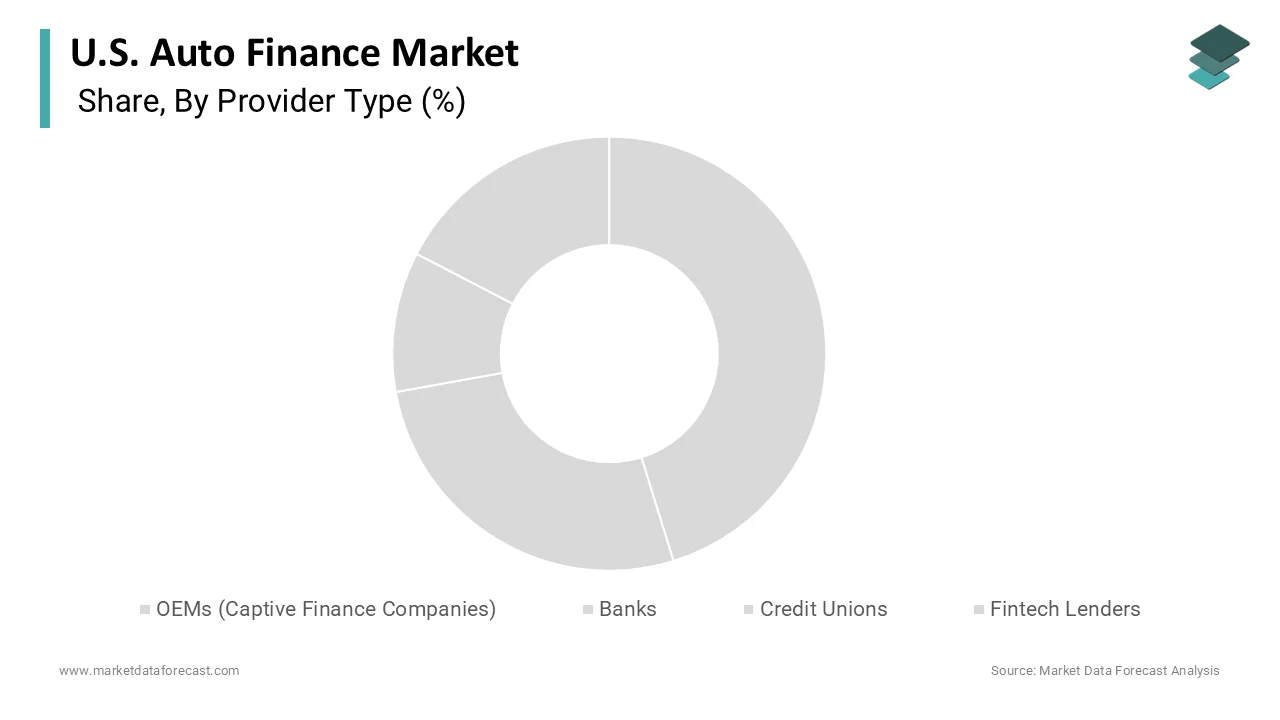
The Original Equipment Manufacturers (OEMs) segment is projected to register the fastest CAGR of 5.8% from 2026 to 2034. Original Equipment Manufacturers are experiencing rapid growth in the auto finance sector by offering strategic incentives and subvented lease programs that make their vehicles more affordable and attractive to consumers. Captive finance arms of automakers, such as Ford Credit and GM Financial, can subsidize interest rates and lease payments to boost vehicle sales volumes. These subvented deals are often unavailable through traditional banks, giving OEMs a competitive edge in price-sensitive markets. OEMs use financing as a marketing tool to clear inventory of specific models or promote new launches. The strategy allows OEMs to maintain market share during periods of high interest rates by effectively lowering the total cost of ownership for consumers. Additionally, captive lenders have greater flexibility in setting residual values for leases, which enables them to offer lower monthly payments.
By Finance Type Insights
The indirect segment was the largest by capturing 22.3% of the United States auto finance market share in 2025. This one-stop shop approach allows buyers to compare multiple loan offers from different lenders simultaneously without leaving the showroom. This high prevalence is driven by the ease of completing a single credit application that is distributed to a network of participating banks, credit unions, and finance companies. Dealerships act as intermediaries who negotiate terms on behalf of the buyer, which can result in competitive rates for qualified applicants. The Federal Trade Commission states that the transparency of multiple offers empowers consumers to make informed financial decisions quickly. Additionally, indirect lending supports immediate vehicle delivery as approval and funding occur rapidly, often within hours.
The direct lending segment is likely to grow at the fastest CAGR of 6.5% from 2026 to 2034 due to the emergence of digital native lenders and fintech solutions that offer streamlined online application processes and competitive rates. These platforms eliminate the need for dealership intermediaries, allowing consumers to secure pre-approved loans before visiting a showroom. Fintech companies leverage advanced algorithms to assess credit risk quickly,y often providing decisions in minutes rather than days. Direct lenders often have lower overhead costs than traditional banks, which allows them to pass savings on to borrowers in the form of reduced interest rates. The Consumer Federation of America states that direct loans can save consumers an average of 500 USD over the life of the loan compared to indirect financing. Additionally,y digital platforms provide educational resources and calculators that empower borrowers to understand their financial obligations clearly.
By Vehicle Type Insights
The passenger vehicles segment was the largest by occupying a dominant share of the United States auto finance market in 2025. Most households own at least one passenger vehicle, which creates a massive and steady demand for financing. The large installed base ensures a continuous stream of loan originations as vehicles age and require replacement. Personal travel accounts for the majority of vehicle miles traveled annually, reinforcing the necessity of private transport. Lenders benefit from the predictable nature of consumer debt, which allows for accurate forecasting and portfolio management. The National Household Travel Survey indicates that the average household replaces its primary vehicle every six to seven years, creating a recurring cycle of financing needs. Additionally, the popularity of sport utility vehicles and pickup trucks among personal buyers has increased average loan sizes due to higher vehicle prices.
The commercial vehicles segment is expected to witness the fastest CAGR of 7.2% from 2026 to 2034 due to the expansion of e-commerce and the resulting demand for last-mile delivery services. Logistics companies and small businesses are increasing their fleets of vans and trucks to meet consumer expectations for fast shipping. Financial institutions are responding by offering specialized leasing and loan products for commercial fleets that include maintenance and telematics services. Lenders benefit from the predictable cash flows of business borrowers, which reduces credit risk compared to individual consumers. The Small Business Administration states that small businesses are increasingly investing in vehicle assets to support operations, creating new opportunities for commercial auto finance. Additionally, the rise of gig economy delivery platforms has created a new class of owner-operators who require financing for their vehicles.
COMPETITIVE LANDSCAPE
The competition in the United States auto finance market is intense and characterized by the presence of diverse entities, including national banks,s regional credit unions, ns captive finance companies, and emerging fintech firms. Each segment competes on distinct advantages such as interest rates, customer service quality, technological innovation, and brand loyalty. Captive lenders leverage manufacturer relationships to offer subsidized rates that attract buyers to specific brands,d s while banks utilize their large capital bases to provide stable and competitive lending options. Fintech companies disrupt traditional models by offering faster approvals and transparent pricing through digital channels. Price competition remains fierce, particularly during periods of high inventory,y when lenders use promotional rates to stimulate demand. Non-price competition focuses on user experience with seamless digital interfaces becoming a key differentiator. Regulatory scrutiny adds complexity, requiring all participants to maintain high compliance standards, which can act as a barrier to entry for smaller firms. Consolidation activities are common as larger institutions acquire niche players to expand capabilities.
KEY MARKET PLAYERS
Some of the companies that are playing a dominating role in the U.S. Auto Finance Market include
- Ally Financial Inc.
- Capital One Financial Corporation
- Ford Motor Credit Company LLC
- Toyota Financial Services
- GM Financial Inc.
- Wells Fargo & Company
- Bank of America Corporation
- JPMorgan Chase & Co.
- Santander Consumer USA Holdings Inc.
- TD Auto Finance
- Huntington Bancshares Incorporated
- Credit Acceptance Corporation
TOP LEADING PLAYERS IN THE MARKET
- Ally Financial Inc is a leading digital financial services company that plays a pivotal role in the United States auto finance market through its extensive lending and leasing operations. The company serves millions of consumers and dealerships by offering competitive loan products and innovative digital solutions. Ally has strengthened its market position by investing heavily in technology to streamline the application process and enhance customer experience. Recent initiatives include the expansion of its digital retailing platform, which allows buyers to complete transactions online with ease. The firm also focuses on data analytics to improve risk assessment and underwriting accuracy. The company actively promotes financial literacy and responsible lending practices to build trust with borrowers. Its commitment to sustainability includes financing options for electric vehicles, which aligns with industry trends. Ally continues to innovate by integrating artificial intelligence into its service offerings to provide personalized financial advice.
- JPMorgan Chase and Co is a global financial services firm with a significant presence in the United States auto finance market through its consumer and community banking division. The bank provides auto loans and leases to individual customers and small businesses,s leveraging its vast branch network and digital platforms. This strategy encourages cross-selling and increases customer retention. The company recently upgraded its mobile application to offer seamless loan management and instant approval capabilities. It also employs advanced machine learning algorithms to detect fraud and assess creditworthiness more effectively. JPMorgan Chase collaborates with automotive retailers to offer promotional financing deals that drive sales volume. The bank emphasizes security and transparency in its lending practices to maintain regulatory compliance and consumer confidence.
- Ford Motor Credit Company LLC is the captive finance arm of Ford Motor Company and a major participant in the United States auto finance market. The company specializes in providing financing and leasing solutions for Ford and Lincoln vehicles to dealers and customers. Ford Credit strengthens its market position by offering subvented rates and incentives that make Ford vehicles more affordable and attractive to buyers. It closely integrates its financial products with vehicle sales strategies to support brand loyalty and market share growth. The company has invested in digital tools that simplify the buying process for both dealers and consumers. Ford Credit also focuses on expanding its electric vehicle financing options to support the transition to sustainable mobility. It utilizes proprietary data from connected vehicles to better understand usage patterns and manage residual values. The firm maintains strong relationships with dealership networks, KS, ensuring preferential treatment for Ford-branded inventory.
TOP STRATEGIES USED BY KEY MARKET PARTICIPANTS
Key players in the United States auto finance market employ several strategic initiatives to maintain competitiveness and drive growth. Digital transformation is a primary focus as companies invest in online platforms and mobile applications to enhance customer convenience and streamline loan origination processes. Artificial intelligence and machine learning are utilized to improve credit scoring models and detect fraud more accurately. Strategic partnerships with automotive manufacturers and dealerships enable lenders to offer integrated financing solutions at the point of sale. Companies also expand their product portfolios to include electric vehicle financing and subscription-based mobility services. Risk management strategies involve diversifying loan portfolios and adjusting underwriting criteria in response to economic conditions. Customer retention is prioritized through loyalty programs and personalized service offerings. Regulatory compliance remains a critical component of strategy, with firms investing in legal and operational frameworks to adhere to evolving laws.
MARKET SEGMENTATION
This research report on the U.S. auto finance market is segmented and sub-segmented into the following categories.
By Provider Type
- OEMs (Captive Finance Companies)
- Banks
- Credit Unions
- Fintech Lenders
- Others
By Purpose Type
- Loans
- Leasing
By Vehicle Type
- Passenger Cars
- Commercial Vehicles
By Country
- California
- Texas
- Florida
- New York
- Rest of the United States