- Product Description Description
- Table of Contents TOC
- List of Table & Figure LOT
- Get Free Sample PDF Sample PDF
Market Size, 2025
$9.05 BnMarket Estimate, 2026
$10.22 BnMarket Forecast, 2034
$26.92 BnCAGR, 2026–2034
12.87%Executive Summary: North America Intelligent Vending Machine Market
- Market Scope: Comprehensive regional North America intelligent vending machine market analysis covering product categories, application verticals, technological integrations, regulatory frameworks, and automated retail infrastructure metrics.
- Market Valuation: Valued at USD 9.05 billion (2025 base year), estimated at USD 10.22 billion (2026), and projected to reach USD 26.92 billion by 2034, registering a rapid CAGR of 12.87% (2026–2034).
- Primary Growth Drivers: High demand for automated convenience, cashless transaction adoption, and real-time inventory optimization. Key technological, operational, and structural highlights include intelligent vending machines increasingly integrating IoT sensors, cashless payments, real-time inventory tracking, and AI-driven analytics, while fragmented municipal licensing requirements can delay deployments by up to six months.
Key Market Segment Metrics (2026–2034)
| Category | Leading Segment (2025 Position) | Fastest-Growing Segment |
|---|---|---|
| By Product Segment | Snacks (dominated product segment with 45.6% of the market in 2025, driven by on-the-go demand) | Food / Fresh Meals (projected to expand at a robust CAGR of 12.4% through 2034) |
| By Application Segment | Offices & Corporate Workplaces (led application segment with 36.4% share in 2025; multi-story layouts typically require 3–5 strategic units) | Educational Institutes (projected to record the fastest CAGR of 14.2% through 2034) |
| By Technology & Features | Standard Telemetry, Cashless POS Terminals, & Basic Inventory Monitoring | AI-Powered Recommendations, Dynamic Pricing, & IoT Remote Management Systems |
| By Country / Region | United States (held the dominant regional market position in 2025) | North American Urban Commercial Centers & Smart Campus Networks |
Major Market Players & Market Structure
Market Structure: Highly competitive North American automated retail and unattended commerce landscape featuring major multinational hardware manufacturers and technology providers competing intensely on AI-powered consumer recommendations, touchless payment integrations, IoT-enabled telemetry, remote stock management, and customized multi-product vending configurations.
Key Companies: Jofemar SA, Westomatic, N&W Global Vending S.p.A., Rheavendors Servomat, Bianchi Vending, Fas International, Azkoyen, Advantech, Royal Vendors, Sanden Corp, Seagate Technology Holdings PLC, and Crane Co.
North America Intelligent Vending Machine Market Size
The Intelligent vending machine market size in North America was valued at USD 9.05 billion in 2025 and is predicted to be worth USD 26.92 billion by 2034 from USD 10.22 billion in 2026, growing at a CAGR of 12.87% from 2026 to 2034.
Intelligent vending machines utilize advanced technologies such as IoT sensors, cashless payment systems, real-time inventory tracking, and AI-driven analytics to deliver enhanced user experiences. Unlike traditional vending models, intelligent systems enable remote monitoring, predictive maintenance, and dynamic pricing strategies. This transformation is supported by increasing deployment in non-traditional environments such as corporate offices, universities, healthcare facilities, and transit hubs, reflecting a shift from convenience-based to experience-based consumption.
 MARKET DRIVERS
Rising Demand for Cashless Payment Solutions
The proliferation of contactless transactions has significantly influenced the adoption of intelligent vending machines throughout North America. Post-pandemic behavioral shifts have accelerated the preference for hygienic, touch-free purchasing methods. This trend is particularly evident in urban centers like New York and Los Angeles, where a notable portion of public transit stations have integrated cashless vending systems. Additionally, cashless transactions reduced transaction time, improving operational efficiency. Intelligent vending machines equipped with NFC, QR code scanners, and EMV chip readers align with this demand, offering secure and swift payment experiences. This driver not only enhances user satisfaction but also reduces maintenance costs related to cash handling, making it a critical element propelling market expansion.
Expansion of Smart City Initiatives
Urban development strategies centered around smart city frameworks are increasingly incorporating intelligent vending machines as part of broader digital infrastructure plans. Municipal governments across North America are prioritizing technology-enabled solutions to improve citizen engagement and optimize resource utilization. Also, the initiatives often involve partnerships with private vendors, driving demand for modular, scalable vending platforms. Moreover, regulatory and strategic push underscores how intelligent vending machines are becoming embedded in urban planning, serving as both service delivery points and data collection nodes.
MARKET RESTRAINTS
High Initial Capital Investment and Maintenance Costs
Despite growing interest, the upfront capital expenditure required for intelligent vending machines remains a significant barrier for many operators. Advanced features such as real-time analytics, cloud integration, and touchscreen interfaces increase hardware and software costs substantially compared to conventional models. Furthermore, ongoing expenses related to connectivity, cybersecurity, and system updates add to the total cost of ownership. In addition, maintenance complexity increases due to reliance on integrated electronics, which require specialized technical expertise. These economic challenges particularly affect independent operators and franchise owners who lack access to enterprise-level funding, thereby limiting widespread adoption despite long-term benefits.
Cybersecurity Vulnerabilities and Data Privacy Concerns
As intelligent vending machines become more interconnected, they face heightened exposure to cyber threats, raising concerns among stakeholders regarding data privacy and system integrity. These devices collect sensitive consumer information including payment details, purchase history, and geolocation data, making them attractive targets for malicious actors. Additionally, compliance with data protection regulations such as GDPR and CCPA adds operational complexity and legal liability. Vendors are compelled to invest heavily in encryption protocols, secure firmware updates, and intrusion detection systems, further escalating costs. Until robust, standardized security measures are universally adopted, these vulnerabilities will continue to hinder trust and slow down-market penetration.
MARKET OPPORTUNITIES
Growth in Health-Conscious and Functional Product Offerings
Consumer preferences are shifting toward healthier, functional, and personalized food and beverage options, creating a lucrative opportunity for intelligent vending machines to diversify product portfolios. Intelligent vending systems can dynamically adjust inventory based on real-time demand analytics and promote specific items tailored to user profiles or dietary needs. Companies like Farmer’s Fridge and FreshDirect have already introduced refrigerated smart kiosks offering fresh salads, smoothies, and organic meals, reporting higher sales conversion rates compared to traditional snack machines. Moreover, the ability to offer allergen-free, plant-based, and locally sourced products through targeted promotions enables operators to tap into niche markets. This trend presents a compelling value proposition for operators to differentiate offerings while meeting evolving consumer expectations.
Integration with Corporate Wellness and Employee Engagement Programs
Corporate organizations across North America are increasingly integrating intelligent vending machines into comprehensive employee wellness and engagement initiatives. With rising awareness about workplace productivity and mental well-being, employers are leveraging smart vending technology to provide nutritious snacks, hydration stations, and even mental health support tools. Microsoft, Google, and Amazon have installed interactive vending units that dispense not only snacks but also branded merchandise, fitness trackers, and mindfulness aids, enhancing employee experience. Additionally, intelligent systems enable HR departments to gather anonymized consumption data, helping tailor future wellness campaigns. This convergence of technology and organizational culture opens new revenue streams for vendors while promoting healthier lifestyles.
MARKET CHALLENGES
Fragmented Regulatory Landscape Across Jurisdictions
The lack of uniform regulatory standards across states and municipalities is one of the persistent challenges facing the North America intelligent vending machine market. Each jurisdiction may impose distinct requirements concerning product safety, labeling, taxation, accessibility, and vending location permits, complicating compliance for operators. This regulatory fragmentation increases administrative overhead and necessitates customized system configurations, undermining scalability. Legal experts from the American Bar Association emphasize that navigating varying licensing procedures can delay deployments by up to six months. Operators must also account for differing sales tax rates and reporting obligations, which vary significantly between jurisdictions. As per the Tax Foundation, discrepancies in state-level tax policies create additional complexities for multi-state vending networks. Without harmonized regulatory frameworks, businesses face inefficiencies that could stifle innovation and limit geographic expansion.
Limited Consumer Awareness and Adoption Barriers
Although intelligent vending machines offer numerous advantages, limited consumer awareness and unfamiliarity with advanced functionalities pose a notable challenge to market growth. Many users remain unaware of features such as personalized recommendations, loyalty integration, and real-time inventory updates, resulting in underutilization of premium capabilities. This knowledge gap is particularly pronounced in rural and suburban demographics, where traditional vending still dominates. Additionally, older consumer segments exhibit resistance to adopting new technologies. Educational campaigns and user interface improvements are essential to bridge this divide. However, without targeted marketing efforts and demonstration programs, the full potential of intelligent vending systems remains untapped, particularly among price-sensitive and less tech-savvy populations.
REPORT COVERAGE
| REPORT METRIC | DETAILS |
| Market Size Available | 2025 to 2034 |
| Base Year | 2025 |
| Forecast Period | 2026 to 2034 |
| CAGR | 12.87% |
| Segments Covered | By Product, Application, and Region |
|
Various Analyses Covered | Regional & Country Level Analysis, Segment-Level Analysis, DROC, PESTLE Analysis, Porter’s Five Forces Analysis, Competitive Landscape, Analyst Overview on Investment Opportunities |
| Regions Covered | The United States, Canada, Mexico, and Rest of North America |
| Market Leaders Profiled | Jofemar SA (Spain), Westomatic (UK), N&W Global Vending S.p.A. (Italy), Rheavendors Servomat (Germany), Bianchi Vending (Italy), Fas International (Italy), Azkoyen (Spain), Advantech (Taiwan), Royal Vendors (USA), Sanden Corp (Japan), Seagate Technology Holdings PLC (Ireland), and Crane Co., and others |
SEGMENTAL ANALYSIS
By Product Insights
The snacks segment dominated the North America intelligent vending machine market by accounting for a 45.6% of the total share in 2025. The dominance of this segment is primarily attributed to the consistent consumer demand for convenient, on-the-go snacking solutions across diverse environments. The segment's prevalence is further reinforced by the high frequency of snack purchases compared to other product categories, making it a preferred choice for operators seeking recurring revenue streams.
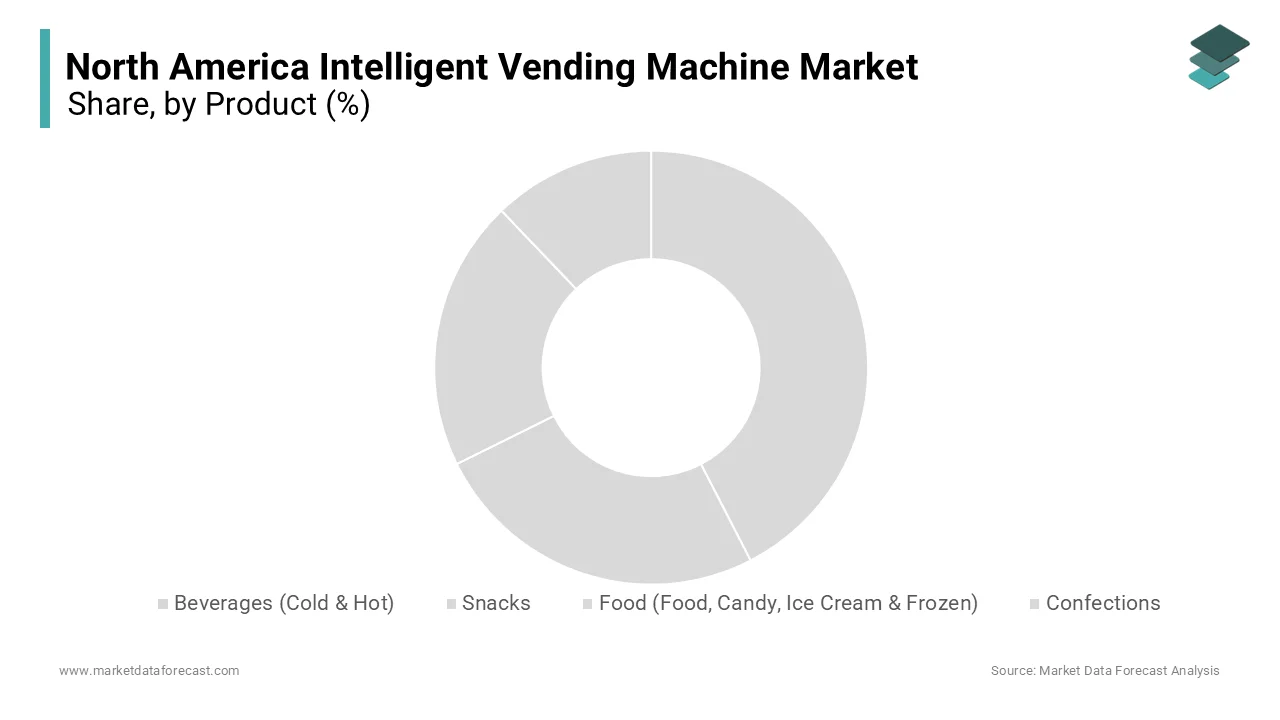
North American consumers exhibit strong snacking habits throughout the day. This behavioral pattern translates directly into vending machine utilization, particularly during mid-morning and afternoon hours when energy levels typically decline. The consistent demand pattern ensures steady revenue generation for vending operators, making snacks the most reliable product category in terms of turnover and profitability. The convenience factor associated with snack items also aligns perfectly with the fast-paced North American lifestyle, where time constraints often influence purchasing decisions.
Intelligent vending technology has revolutionized snack distribution by enabling personalized recommendations and dynamic inventory management based on consumer preferences and purchasing patterns. Modern systems utilize machine learning algorithms to analyze buying behaviors and suggest relevant snack options, resulting in higher conversion rates compared to traditional vending machines. The ability to track inventory in real-time allows operators to maintain optimal stock levels of popular snack items, reducing out-of-stock scenarios. Additionally, smart vending systems can accommodate diverse dietary preferences including gluten-free, organic, and protein-enhanced snacks. The integration of touchscreen interfaces and mobile payment solutions has further enhanced the user experience, leading to increased customer satisfaction scores and repeat purchases. These technological advancements have made snack vending more efficient and appealing to consumers, solidifying its position as the dominant product segment.
The food segment represents the fastest-growing category in the North America intelligent vending machine market and is projected to achieve a compound annual growth rate of 12.4% through 2034. This remarkable growth trajectory is driven by evolving consumer expectations for fresh, healthy, and convenient meal solutions that align with modern dietary preferences and time constraints. The increasing consumer focus on health and wellness has created significant demand for fresh food options within vending environments. This trend has prompted vending operators to introduce refrigerated units offering salads, sandwiches, yogurt bowls, and other perishable items that maintain quality and safety standards. The ability of intelligent vending systems to maintain proper temperature control and track expiration dates ensures food safety compliance while reducing waste. Additionally, the COVID-19 pandemic accelerated consumer preference for individually packaged and contactless food service options. This shift in consumer behavior has created substantial opportunities for food vending operators to expand their offerings beyond traditional packaged items.
Corporate organizations across North America are increasingly recognizing the importance of providing nutritious meal options to support employee wellness and productivity Major technology companies like Google and Microsoft have implemented smart food vending systems that offer chef-prepared meals, fresh fruit, and protein-rich options, resulting in higher employee satisfaction ratings. Intelligent vending systems enable employers to track consumption patterns and customize offerings based on employee preferences, creating personalized dining experiences that enhance workplace culture. Furthermore, the integration of corporate cafeteria systems with smart vending networks allows for seamless meal distribution across multiple locations, supporting hybrid work models and distributed teams. This institutional adoption has created a sustainable demand driver for the food vending segment, contributing to its rapid expansion.
By Application Insights
The offices segment commanded the largest share of the North America intelligent vending machine market with 36.4% share in 2025. This dominant position is primarily attributed to the high concentration of working professionals in corporate environments and the consistent demand for convenient refreshment solutions throughout the workday. Office buildings, particularly those housing large employee populations, require multiple vending units to serve diverse needs ranging from morning coffee to afternoon snacks and evening meal replacements.
Office environments typically accommodate large numbers of employees who spend 8-10 hours daily in the workplace, creating consistent demand for vending machine services throughout business hours. Multi-story office buildings often require 3-5 strategically placed vending units to adequately serve employee populations, with high-traffic areas such as break rooms, lobbies, and near elevators commanding premium placement fees. Additionally, the concentration of users in single locations allows operators to optimize routes and reduce maintenance costs, making office installations highly profitable compared to dispersed retail environments. This density factor creates economies of scale that support the segment's dominant market position.
Modern corporate environments increasingly prioritize employee wellness and satisfaction, leading to investments in premium vending solutions that align with organizational health initiatives. Corporate contracts for vending services typically command higher rates compared to other applications due to the volume potential and long-term contract structures. Major corporations often require customized solutions including branded interfaces, employee discount programs, and integration with corporate ID systems, creating additional revenue opportunities for vending operators. The ability to provide real-time consumption data and nutritional information supports corporate health tracking initiatives, making intelligent vending systems valuable partners in workplace wellness strategies. Furthermore, the integration of contactless payment solutions and mobile ordering capabilities enhances user experience while supporting corporate security protocols. These value-added services command premium pricing and create sustainable competitive advantages for operators serving the office segment.
The educational institutes segment represents the fastest-growing application area in the North America intelligent vending machine market and is projected to achieve a compound annual growth rate of 14.2% through 2034. This rapid expansion is driven by increasing student populations, campus modernization initiatives, and evolving expectations for technology-enabled services within academic environments.
North American educational institutions are experiencing steady enrollment growth, particularly in community colleges and universities that serve diverse student demographics including traditional residential students and working adults pursuing continuing education. Modern campus development projects increasingly incorporate smart building technologies and automated services, with vending systems serving as integral components of student life infrastructure. University residence halls typically require 2-3 vending units per floor to adequately serve student populations, while academic buildings, libraries, and student centers create additional deployment opportunities. The extended operating hours of educational facilities, including 24/7 access in dormitories and study areas, generate consistent revenue potential that attracts vending operators. Additionally, the diverse demographic composition of student populations creates opportunities for specialized product offerings including international cuisine, dietary-specific options, and late-night meal solutions that command premium pricing.
Students represent early adopters of new technologies and demonstrate strong preferences for digital payment solutions, mobile ordering, and personalized service experiences. Educational institutions are investing in integrated campus card systems that combine ID functionality with payment capabilities, creating seamless user experiences that drive vending machine utilization rates higher than traditional cash-based systems. The integration of vending systems with student information systems enables personalized recommendations based on dietary restrictions, academic schedules, and spending patterns, enhancing user satisfaction and loyalty. Social media integration and gamification features within intelligent vending platforms appeal to student demographics seeking interactive and shareable experiences. Additionally, the ability to provide real-time inventory updates and product availability information through mobile applications reduces user frustration and increases transaction completion rates. Campus administrators appreciate the data analytics capabilities that support operational efficiency and student behavior insights, making intelligent vending systems valuable components of broader campus technology ecosystems. This alignment between student preferences and technological capabilities creates strong growth momentum for the educational institute segment.
REGIONAL ANALYSIS
United States
The United States represented the dominant force in the North America intelligent vending machine market by commanding substantial share in 2025. This overwhelming dominance is attributed to the country's large population base, extensive commercial infrastructure, advanced technological adoption rates, and sophisticated retail environments that create substantial demand for automated retail solutions.
The United States maintains an unrivaled position in the North American intelligent vending machine landscape, supported by its massive consumer base, diverse commercial applications, and progressive regulatory environment that encourages technological innovation. The country's economic strength and business-friendly policies have fostered a thriving ecosystem for vending technology development and deployment, establishing it as the primary market driver for the entire region.
The U.S. intelligent vending machine market is characterized by rapid technological advancement, diverse product offerings, and strong institutional adoption across corporate, educational, and healthcare sectors. The market benefits from robust venture capital investment in vending technology startups. Corporate wellness initiatives have emerged as significant demand drivers. The integration of IoT connectivity and AI-powered analytics has enabled operators to achieve higher profit margins compared to traditional vending systems. Additionally, the country's diverse demographic composition creates opportunities for specialized product offerings including ethnic foods, dietary-specific items, and premium beverages that command higher pricing and generate increased revenue per transaction.
Canada
Canada is distinguished by its progressive regulatory framework, strong emphasis on sustainability, and high adoption rates of cashless payment technologies that create favorable conditions for intelligent vending system deployment. Canada maintains a significant presence in the North American intelligent vending landscape, driven by its affluent consumer base, environmentally conscious policies, and government support for technological innovation in retail environments. The country's bilingual nature and multicultural demographics create unique opportunities for diverse product offerings while its proximity to the United States facilitates technology transfer and market development synergies.
The Canadian intelligent vending machine market demonstrates strong growth potential, supported by increasing corporate investments in employee wellness programs and expanding educational infrastructure. The federal government's commitment to reducing carbon emissions has encouraged operators to adopt energy-efficient vending technologies. Healthcare institutions represent a particularly strong growth segment. The widespread adoption of contactless payment methods has accelerated demand for advanced vending solutions. Additionally, the country's universal healthcare system creates opportunities for vending systems that dispense over-the-counter medications and health-related products, expanding the traditional product scope and creating new revenue streams for operators.
KEY MARKET PLAYERS AND COMPETITIVE LANDSCAPE
Jofemar SA (Spain), Westomatic (UK), N&W Global Vending S.p.A. (Italy), Rheavendors Servomat (Germany), Bianchi Vending (Italy), Fas International (Italy), Azkoyen (Spain), Advantech (Taiwan), Royal Vendors (USA), Sanden Corp (Japan), Seagate Technology Holdings PLC (Ireland), and Crane Co. are the key players in the North American intelligent vending machine market.
The North American intelligent vending machine market is characterized by intense competition among established beverage giants, emerging technology startups, and traditional vending equipment manufacturers. The competitive landscape is shaped by rapid technological advancement, evolving consumer preferences, and increasing demand for personalized experiences. Major players are continuously innovating to differentiate their offerings through advanced features such as AI-powered recommendations, contactless payment solutions, and real-time inventory management systems. The market also witnesses significant consolidation activity as larger companies acquire specialized technology providers to enhance their capabilities and expand their market presence. Competition is further intensified by the entry of new players offering innovative business models such as subscription-based services and shared vending networks. Regional players maintain strong positions in specific geographic markets through localized product offerings and established distribution networks, creating a fragmented yet dynamic competitive environment that drives continuous innovation and improvement in service quality.
TOP PLAYERS IN THE MARKET
Coca-Cola Company
Coca-Cola stands as a dominant force in the North American intelligent vending machine market through its extensive portfolio of smart beverage dispensing solutions. The company has strategically integrated IoT technology into its Freestyle and Freestyle Edge platforms, enabling real-time inventory tracking, personalized drink recommendations, and dynamic pricing capabilities. Their focus on cashless payment integration and mobile app connectivity has transformed traditional beverage vending into interactive consumer experiences. Coca-Cola's substantial investment in digital transformation and partnership ecosystem development has positioned them at the forefront of beverage automation technology.
PepsiCo Inc.
PepsiCo has established itself as a key player through innovative vending solutions that combine snack and beverage offerings with advanced technology features. The company's smart vending systems incorporate AI-driven analytics to optimize product placement and inventory management while providing consumers with personalized recommendations. Their commitment to health-conscious offerings and sustainable packaging solutions has differentiated their vending portfolio in the competitive landscape. PepsiCo's strategic acquisitions and technology partnerships have enabled them to develop comprehensive vending ecosystems that serve diverse market segments.
Farmer's Fridge
Farmer's Fridge has revolutionized the food vending segment by introducing refrigerated smart kiosks that dispense fresh, healthy meals and snacks. The company's innovative approach combines automated retail technology with farm-to-table freshness, offering consumers nutritious options that were previously unavailable in traditional vending environments. Their cloud-connected systems enable real-time inventory management and quality control while providing valuable consumer data insights. Farmer's Fridge has successfully expanded beyond conventional snack vending to establish a new category of fresh food automation.
TOP STRATEGIES USED BY KEY PLAYERS
Technology Integration and IoT Connectivity Leading players in the North American intelligent vending machine market are focusing heavily on integrating advanced IoT technologies to create connected ecosystems that enable real-time monitoring, predictive maintenance, and data-driven decision making. This strategy involves incorporating sensors, cloud connectivity, and mobile applications to transform traditional vending machines into smart retail platforms that can adapt to consumer preferences and optimize operational efficiency.
Strategic Partnerships and Acquisitions Major market participants are actively pursuing strategic partnerships with technology companies, software developers, and complementary service providers to enhance their capabilities and expand their market reach. These collaborations enable vendors to access new technologies, enter adjacent market segments, and leverage existing distribution networks while reducing time-to-market for innovative solutions.
Product Diversification and Customization Companies are increasingly focusing on expanding their product portfolios beyond traditional snack and beverage offerings to include fresh foods, health-conscious options, and specialized items that cater to specific dietary requirements. This strategy involves developing modular vending systems that can accommodate diverse product categories while offering personalized experiences through data analytics and consumer profiling capabilities.
RECENT HAPPENINGS IN THE MARKET
- In March 2025, Coca-Cola Company announced the launch of its next-generation Freestyle Edge vending platform featuring enhanced AI capabilities and expanded payment options across major metropolitan areas in the United States and Canada.
- In June 2025, PepsiCo Inc. acquired SmartSnacks Technology, a startup specializing in health-focused vending solutions, to strengthen its position in the growing wellness segment and expand its digital vending capabilities.
- In September 2025, Farmer's Fridge partnered with Microsoft to integrate Azure cloud services into its refrigerated vending systems, enabling advanced analytics and predictive maintenance capabilities across its network of fresh food kiosks.
- In January 2025, Crane Merchandising Systems introduced its new Apollo smart vending platform with integrated biometric payment authentication and personalized recommendation engines for corporate and educational markets.
- In August 2025, SandenVendo North America collaborated with Visa to develop contactless payment solutions specifically designed for vending machines, enhancing transaction security and user experience across multiple market segments.
MARKET SEGMENTATION
This research report on the North America intelligent vending machine market has been segmented and sub-segmented based on the following categories.
By Product
- Beverages (Cold & Hot)
- Snacks
- Food (Food, Candy, Ice Cream & Frozen)
- Confections
By Application
- Manufacturing
- Offices
- Commercial Malls & Retail Stores
- Educational Institutes
- Others
By Country
- The United States
- Canada
- Rest of North America