- Product Description Description
- Table of Contents TOC
- List of Table & Figure LOT
- Get Free Sample PDF Sample PDF
Market Size, 2025
$29.55 BnMarket Estimate, 2026
$40.50 BnMarket Forecast, 2034
$504.71 BnCAGR, 2026–2034
37.07%Latin America Artificial Intelligence Market Size
The size of the Latin America artificial intelligence market was valued at USD 29.55 billion in 2025. This market is expected to grow at a CAGR of 37.07% from 2026 to 2034 and be worth USD 504.71 billion by 2034 from USD 40.50 billion in 2026.
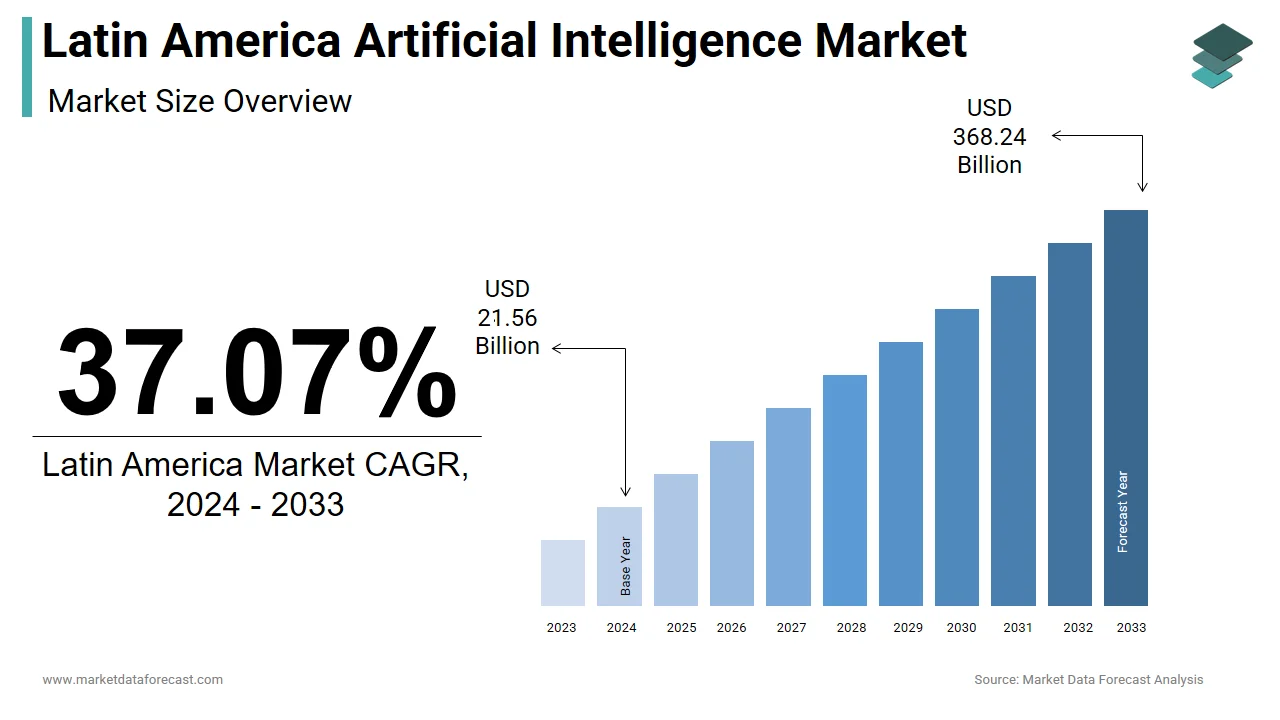
The adoption and deployment of AI-based technologies across industries such as banking, financial services, insurance (BFSI), healthcare, retail, manufacturing, and government is anticipated to fuel the growth of the Latin America artificial intelligence market. This includes machine learning, natural language processing, computer vision, robotic process automation, and other advanced analytics solutions tailored for business applications.
MARKET DRIVERS
Rising Digital Transformation Across Key Sectors
The accelerated pace of digital transformation across key economic sectors is driving the growth of the Latin America artificial intelligence market. Companies are increasingly adopting AI to enhance productivity, automate repetitive tasks, and improve customer engagement. According to IDC, over 65% of enterprises in Brazil and Mexico initiated AI-driven digital transformation projects between 2021 and 2023 in customer service automation, supply chain optimization, and personalized marketing. In the banking and financial services sector, AI is being used to streamline loan approvals, detect fraudulent transactions, and offer chatbot-based support. As reported by McKinsey & Company, Brazilian banks have reduced manual loan processing time by up to 40% through AI-enabled credit scoring models, which is significantly improving turnaround times and user satisfaction. Additionally, the healthcare industry is leveraging AI for diagnostics, drug discovery, and patient monitoring.
Government Initiatives and Public Sector Adoption of AI
Government-led initiatives and increased public sector adoption of artificial intelligence are significantly contributing to the growth of the Latin America artificial intelligence market. Several countries have introduced national AI strategies to foster research, regulate ethical use, and integrate AI into public administration. In Brazil, the National Strategy for Artificial Intelligence (ENIA) was launched in 2022 with a focus on promoting responsible AI development and supporting local innovation ecosystems. As reported by the Ministry of Science, Technology, and Innovation (MCTI), this initiative led to the establishment of over 20 AI research hubs across universities and private institutions in two years, which is fostering collaboration between academia and industry.
MARKET RESTRAINTS
Lack of Skilled AI Talent and Research Infrastructure
The shortage of skilled professionals and inadequate research infrastructure needed to support large-scale AI development and implementation is limiting the growth of the Latin America artificial intelligence market. In Brazil, one of the most developed markets in the region, only 12,000 professionals possess advanced AI and machine learning skills, as reported by the Brazilian Association of Artificial Intelligence (ABIA). The situation is even more pronounced in smaller economies like Peru and Ecuador, where universities lack dedicated AI programs and industry partnerships to train next-generation talent. As per UNESCO, fewer than 10 universities in Latin America offer specialized postgraduate degrees in AI, further exacerbating the skill gap.
Data Privacy Concerns and Regulatory Uncertainty
The data privacy concerns and inconsistent regulatory frameworks pose a major challenge to the Latin America artificial intelligence market. While AI depends heavily on data availability and quality, many countries in the region lack comprehensive legal structures to govern data usage, protection, and ethical AI deployment. Brazil enacted the General Data Protection Law (LGPD) in 2020, modeled after the European Union’s GDPR, but enforcement remains inconsistent due to bureaucratic inefficiencies and unclear guidelines from the National Data Protection Authority (ANPD). As reported by Deloitte, over 40% of Brazilian companies delayed AI initiatives in 2023 due to compliance concerns, which is fearing potential penalties for non-compliance.
MARKET OPPORTUNITIES
Expansion of AI in Financial Inclusion and Fintech Innovation
AI is enabling new models of credit assessment, micro-lending, and digital payments that cater to unbanked and underbanked populations with a large portion of the population historically underserved by traditional banking institutions. According to the World Bank, nearly 45% of adults in Latin America remain outside the formal financial system, which presents a vast opportunity for AI-powered financial services. Fintech startups in Brazil, Mexico, and Colombia are leveraging AI algorithms to analyze alternative data sources such as mobile phone usage, utility payments, and social media activity to assess creditworthiness without relying solely on traditional credit histories. In Mexico, AI-powered neobanks like Stori and Konfio have gained traction by using machine learning to provide instant credit decisions to consumers previously excluded from mainstream finance.
Growth of AI in Agriculture and Smart Farming Solutions
Another transformative opportunity for the Latin America artificial intelligence market is its application in agriculture and smart farming technologies. According to the Food and Agriculture Organization (FAO), agriculture accounts for nearly 5% of Latin America’s total GDP, which makes it a critical sector for AI-driven innovation. Startups and agritech firms in Brazil and Argentina are developing AI-powered tools that analyze satellite imagery, weather patterns, and soil data to guide farmers in real-time decision-making. As reported by AgriTech Latam, over 30 AI-based agritech companies emerged in Latin America between 2021 and 2023, offering predictive analytics for harvest forecasting and resource allocation. In Brazil, Embrapa, the country’s agricultural research corporation, has partnered with AI developers to create smart drones and sensors that monitor crop health and recommend targeted interventions. Similarly, in Argentina, AI-driven platforms like Satellogic use high-resolution Earth imaging combined with machine learning to provide insights on land productivity and climate impact, as per Buenos Aires-based tech incubator Wayra.
MARKET CHALLENGES
High Implementation Costs and Limited Access to AI Infrastructure
The high cost of AI implementation and the limited availability of supporting infrastructure for small and medium-sized enterprises (SMEs) is a challenging factors for the Latin America artificial intelligence market growth. Developing and deploying AI solutions often requires significant investment in cloud computing resources, data storage, and specialized hardware, which many local businesses struggle to afford. According to McKinsey & Company, only 18% of SMEs in Latin America could allocate a budget for AI adoption in 2023, which is largely due to financial constraints and competing priorities. Cloud infrastructure remains concentrated in a few major cities, limiting accessibility for businesses in rural and semi-urban areas. Additionally, bandwidth limitations and inconsistent internet speeds hinder real-time data processing capabilities in countries like Bolivia and Paraguay. Moreover, AI-as-a-Service (AIaaS) offerings are still emerging in the region, with limited local providers capable of delivering cost-effective, scalable solutions.
Cultural Resistance and Low Awareness of AI Benefits
Cultural resistance and low awareness regarding the benefits of artificial intelligence represent another significant challenge in the Latin America artificial intelligence market. Many businesses and consumers remain skeptical about AI due to misconceptions, fear of job displacement, and a general lack of understanding about its practical applications. This skepticism is particularly prevalent among traditional industries such as manufacturing, logistics, and retail, where decision-makers often prefer established methods over experimental technologies.
REPORT COVERAGE
| REPORT METRIC | DETAILS |
| Market Size Available | 2025 to 2034 |
| Base Year | 2025 |
| Forecast Period | 2026 to 2034 |
| Segments Covered | By Solution, Technology, Function, End-Use, and Region. |
| Various Analyses Covered | Global, Regional, and Country-Level Analysis, Segment-Level Analysis, Drivers, Restraints, Opportunities, Challenges; PESTLE Analysis; Porter’s Five Forces Analysis, Competitive Landscape, Analyst Overview of Investment Opportunities |
| Countries Covered | Brazil, Mexico, Argentina, Chile, Rest of Latin America |
| Market Leaders Profiled | Advanced Micro Devices, AiCure, Arm Limited, Atomwise, Inc., Ayasdi AI LLC, Baidu, Inc., Clarifai, Inc., Cyrcadia Health, Enlitic, Inc., Google LLC, H2O.ai, HyperVerge, Inc., IBM (including IBM Watson Health), Intel Corporation, Iris.ai AS, Lifegraph, Microsoft, NVIDIA Corporation, Sensely, Inc., and Zebra Medical Vision, Inc. |
SEGMENTAL ANALYSIS
By Solution Type Insights
The software segment held 48.1% of the Latin America artificial intelligence market share in 2025 with the increasing deployment of AI-powered software solutions in enterprise operations, including chatbots, analytics tools, and automation platforms that enhance productivity and decision-making. Furthermore, cloud-based AI software solutions are gaining momentum due to their scalability and cost-effectiveness. As noted by Gartner, nearly 45% of Latin American enterprises opted for cloud-hosted AI software in 2023 when compared to just 20% in 2021. Additionally, local governments have supported the development of AI software ecosystems through funding programs and regulatory sandboxes by encouraging startups and SMEs to build innovative applications tailored to regional needs.
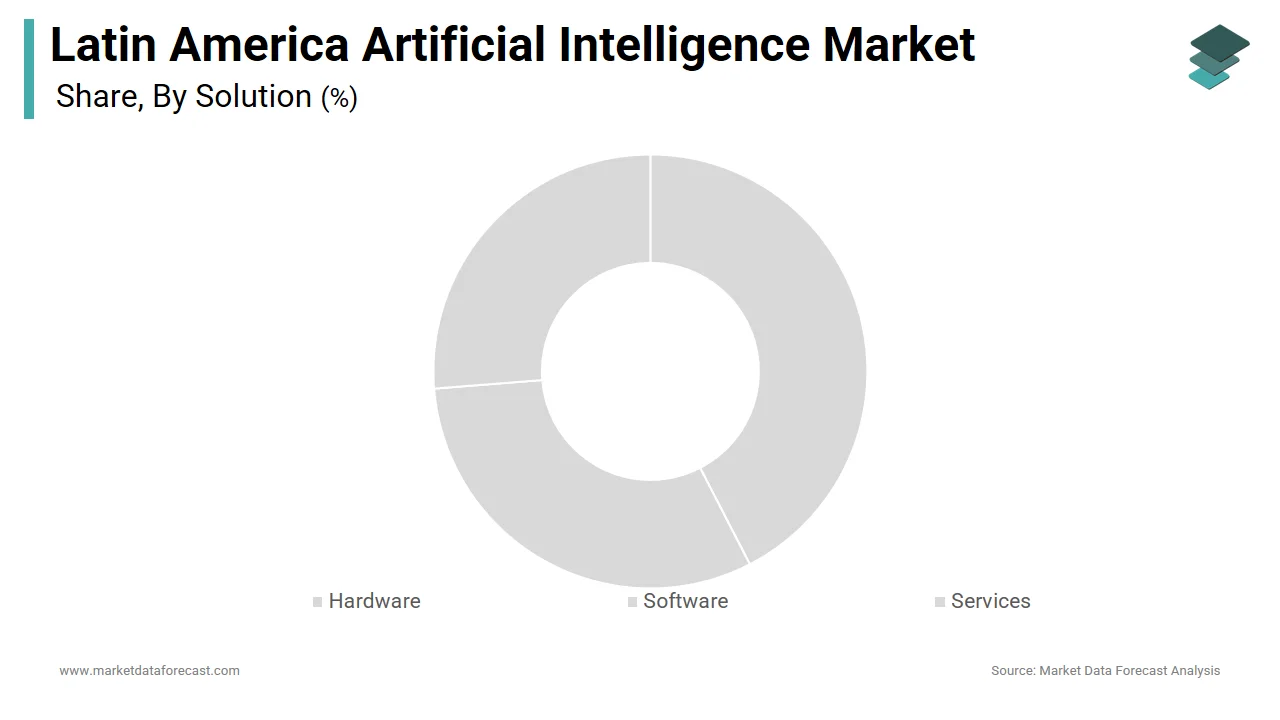
The services segment is expected to grow with a CAGR of 29.3% during the forecast period with the increasing demand for AI consulting, integration, and managed services among businesses lacking in-house expertise but seeking to adopt AI technologies. Additionally, managed AI services are gaining popularity, especially among small and medium-sized enterprises that prefer subscription-based models over upfront investments.
By Technology Insights
The machine learning segment accounted for 32.1% of the Latin America artificial intelligence market share in 2024. Machine Learning adoption has been particularly strong in the financial sector with major banks using it for credit risk modeling and fraud detection. According to IDC, over 55% of Brazilian financial institutions had deployed machine learning-based systems for real-time transaction monitoring in 2023. Additionally, government initiatives aimed at promoting AI research have further accelerated this trend. As per the Ministry of Science, Technology, and Innovation (MCTI) in Brazil, more than 40 public and private institutions launched machine learning-focused projects between 2021 and 2023 by enhancing domestic capabilities and fostering innovation.
The generative AI segment is expected to register a CAGR of 36.3% in the coming years. Startups and digital agencies have rapidly adopted generative AI to streamline marketing campaigns and improve user engagement. According to Distrito.FM, a Brazilian tech ecosystem platform, over 60 new generative AI-based startups were launched in 2023 by focusing on copywriting, image generation, and virtual assistant services. Moreover, academic institutions are also contributing to this growth. The National Autonomous University of Mexico (UNAM) introduced a dedicated generative AI research lab in early 2023 by aiming to explore ethical use cases and develop localized language models tailored for Spanish and Portuguese speakers.
By End-Use Industry Insights
The Banking, Financial Services, and Insurance (BFSI) sector was accounted in holding 27.3% of the Latin America artificial intelligence market share in 2024. In Brazil, major banks such as Itau Unibanco and Banco do Brasil have deployed AI for real-time fraud monitoring, which is significantly improving security and reducing losses. Additionally, AI-driven credit scoring models have expanded financial access to under-banked populations, with Nubank leveraging machine learning to assess alternative creditworthiness indicators, as per its annual sustainability report. Mexico has also witnessed strong BFSI-driven AI adoption in insurance and lending. As reported by AMIPCI, over 40% of Mexican insurers integrated AI into claims processing in 2023 by reducing manual intervention and accelerating settlement timelines. Furthermore, neobanks like Stori and Kueski have leveraged AI chatbots and recommendation engines to enhance user experience and increase customer retention.
The healthcare segment is lucratively to grow with an expected CAGR of 31.2% during the forecast period. AI applications in radiology and pathology have gained momentum with hospitals adopting deep learning-based imaging analysis tools to improve diagnostic accuracy. According to Fundação Oswaldo Cruz, AI-assisted cancer screening tools helped detect early-stage tumors with 90% accuracy in 2023, significantly improving patient outcomes. Additionally, telemedicine platforms like Doctoralia and MedCenter have integrated AI chatbots to triage patients and reduce physician workload, as reported by the Brazilian Health Informatics Association (ABIH). Argentina has also made strides in AI-enabled drug discovery, with biotech firms partnering with academic institutions to accelerate pharmaceutical research. Moreover, Chilean health authorities have begun deploying AI for epidemic prediction and resource allocation by enhancing public health response capabilities.
COUNTRY-LEVEL ANALYSIS
Brazil Artificial Intelligence Market Insights
Brazil was the largest contributor with 38.2% of the Latin America artificial intelligence market share in 2024. According to the Ministry of Science, Technology, and Innovation (MCTI), Brazil’s National Strategy for Artificial Intelligence (ENIA) has facilitated over USD 500 million in public and private sector investments since its launch in 2022 by supporting AI development in key sectors such as finance, healthcare, and agriculture. Enterprise adoption has also surged, with major corporations like Petrobras, Nubank, and Embraer integrating AI into their operations for predictive maintenance, fraud detection, and customer service automation.
Mexico Artificial Intelligence Market Insights
Mexico was positioned next with 25.4% of the Latin America artificial intelligence market share in 2024. According to AMIPCI (Association Mexicana de Internet), the number of AI-driven enterprises in Mexico surpassed 1,200 in 2023, with notable growth in fintech, logistics, and smart city applications. Companies like Group Carso, BBVA Mexico, and America Movil have invested heavily in AI-based customer service platforms, enhancing user experience and operational efficiency. Additionally, the Mexican government has prioritized AI development through initiatives such as the National Digital Strategy, which promotes AI literacy and infrastructure investment. Universities and research institutions are also playing a crucial role in advancing AI capabilities. Moreover, cross-border collaborations with U.S.-based tech firms have enabled knowledge transfer and joint innovation, which is strengthening Mexico’s position as a key player in Latin America’s AI landscape.
Argentina Artificial Intelligence Market Insights
Argentina artificial intelligence market growth is likely to witness the highest CAGR in the coming years. According to the Ministry of Science, Technology, and Innovation, Argentina allocated over USD 120 million in public funding for AI research and development in 2023 by focusing on areas such as fintech, agritech, and biomedical engineering. Buenos Aires has emerged as a regional AI hub, hosting several incubators and accelerators, including Wayra and NXTP Labs, which have supported more than 50 AI-based startups in recent years, as noted by Finnovista.
Chile Artificial Intelligence Market Insights
Chile artificial intelligence market growth is anticipated to grow with its stable economic policies and high levels of digital literacy, Chile has positioned itself as a regional leader in AI adoption, particularly in financial services, smart cities, and environmental monitoring.
According to CORFO (Production Development Corporation), Chile’s AI-related investments exceeded USD 150 million in 2023, with government-backed initiatives such as Start-Up Chile actively supporting AI entrepreneurs and innovators. Santiago has become a thriving center for fintech and insurtech startups, many of which leverage AI for risk assessment, customer segmentation, and claims automation, as reported by Fundación Chile.
COMPETITIVE LANDSCAPE
The Latin America artificial intelligence market is witnessing growing competition as both global technology leaders and regional innovators intensify efforts to capture market share. While multinational corporations bring established AI frameworks and global expertise, local firms are leveraging deep industry knowledge and agile deployment models to offer customized solutions. This dynamic creates a competitive yet collaborative environment where strategic alliances and co-innovation play a vital role in shaping market outcomes.
Competition is further driven by the rapid emergence of AI-focused startups, particularly in Brazil, Mexico, and Argentina, which are introducing niche applications in fintech, agritech, and smart cities. These startups often serve as acquisition targets or partners for larger firms seeking to expand their regional footprint. Additionally, government-backed initiatives aimed at promoting AI development are encouraging homegrown innovation and attracting foreign investment.
Diversity in market participants ranging from enterprise software providers to AI-as-a-service platforms adds complexity to the competitive landscape. Companies must continuously refine their value propositions, focusing on affordability, ease of integration, and regulatory compliance to maintain relevance in this evolving market.
KEY MARKET PLAYERS
Noteworthy Companies dominating the Latin America artificial intelligence market profiled in the report are
- Advanced Micro Devices
- AiCure
- Arm Limited
- Atomwise, Inc.
- Ayasdi AI LLC
- Baidu, Inc.
- Clarifai, Inc.
- Cyrcadia Health
- Enlitic, Inc.
- Google LLC
- H2O.ai
- HyperVerge, Inc.
- IBM (including IBM Watson Health)
- Intel Corporation
- Iris.ai AS
- Lifegraph
- Microsoft
- NVIDIA Corporation
- Sensely, Inc.
- Zebra Medical Vision, Inc.
TOP LEADING PLAYERS IN THE MARKET
One of the leading players in the Latin America artificial intelligence market is IBM, which has been actively supporting AI development across sectors such as healthcare, finance, and government. Through its Watson AI platform, IBM offers cognitive computing solutions tailored to regional needs, enabling businesses to enhance decision-making and operational efficiency through advanced analytics and automation. Another key player is Microsoft, which plays a crucial role in advancing AI adoption in Latin America via its Azure AI suite. The company collaborates with local governments, academic institutions, and enterprises to deploy scalable cloud-based AI solutions. Microsoft’s focus on ethical AI, digital transformation, and AI education programs has significantly contributed to building regional capabilities and fostering innovation ecosystems. Softtek is a major regional player that has made significant contributions to AI implementation across Latin America. Softtek integrates AI into business process automation, customer service optimization, and data analytics for both public and private sector clients as a Mexican-based global IT services provider. Its localized expertise and agile delivery model have enabled organizations to adopt AI more efficiently and sustainably.
TOP STRATEGIES USED BY KEY MARKET PARTICIPANTS
A primary strategy employed by key players in the Latin America artificial intelligence market is deepening partnerships with local startups and research institutions to accelerate AI innovation and tailor solutions to regional requirements. Global and domestic companies can access specialized talent and domain-specific insights that enhance product relevance and scalability by collaborating with emerging tech firms and universities.
Another critical approach is expanding cloud-based AI platforms with localized language support and infrastructure optimization by allowing businesses to leverage AI without heavy upfront investments. Major players are customizing their offerings to accommodate the region's linguistic diversity and varying levels of digital maturity, thereby increasing accessibility for SMEs and large enterprises alike.
Investing in workforce upskilling and AI literacy programs has become essential for market leaders aiming to bridge skill gaps and promote long-term AI adoption. Companies are launching training initiatives, certification courses, and incubation centers to build a sustainable pipeline of AI-ready professionals across Latin America.
RECENT MARKET DEVELOPMENTS
- In February 2023, IBM launched an AI research lab in São Paulo, Brazil, in collaboration with local universities, aiming to develop region-specific AI models and foster innovation in natural language processing for Portuguese-speaking markets.
- In September 2023, Microsoft expanded its Azure AI presence in Mexico by opening a new cloud data center dedicated to AI workloads by enhancing performance and reducing latency for enterprise customers adopting AI-driven applications.
- In June 2024, Softtek partnered with a leading Chilean financial institution to implement AI-powered fraud detection systems, which is strengthening digital security and improving transaction monitoring capabilities across banking operations in South America.
- In November 2023, Google Cloud initiated a partnership with a Brazilian AI startup accelerator to support early-stage ventures focused on machine learning and computer vision by aiming to scale innovative solutions across agriculture and logistics.
- In March 2024, Accenture launched an AI ethics advisory service in Argentina, helping enterprises navigate complex regulatory landscapes and implement responsible AI governance frameworks aligned with international best practices.
MARKET SEGMENTATION
This Latin America artificial intelligence market research report is segmented and sub-segmented into the following categories.
By Solution
- Hardware
- Accelerators
- Processors
- Memory
- Network
- Software
- Services
- Professional
- Managed
By Technology
- Deep Learning
- Machine Learning
- Natural Language Processing (NLP)
- Machine Vision
- Generative AI
By Function
- Cybersecurity
- Finance and Accounting
- Human Resource Management
- Legal and Compliance
- Operations
- Sales and Marketing
- Supply Chain Management
By End-Use
- Healthcare
- Robot Assisted Surgery
- Virtual Nursing Assistants
- Hospital Workflow Management
- Dosage Error Reduction
- Clinical Trial Participant Identifier
- Preliminary Diagnosis
- Automated Image Diagnosis
- BFSI
- Risk Assessment
- Financial Analysis/Research
- Investment/Portfolio Management
- Others
- Law
- Retail
- Advertising & Media
- Automotive & Transportation
- Agriculture
- Manufacturing
- Others
By Country
- Brazil
- Mexico
- Argentina
- Chile
- Rest of Latin America