Global M2M Healthcare Market Size, Share, Trends, & Growth Analysis Report By Type, Application & Region (North America, Europe, APAC, Latin America, Middle East and Africa), Industry Forecast (2026 to 2034)
Global M2M Healthcare Market Size
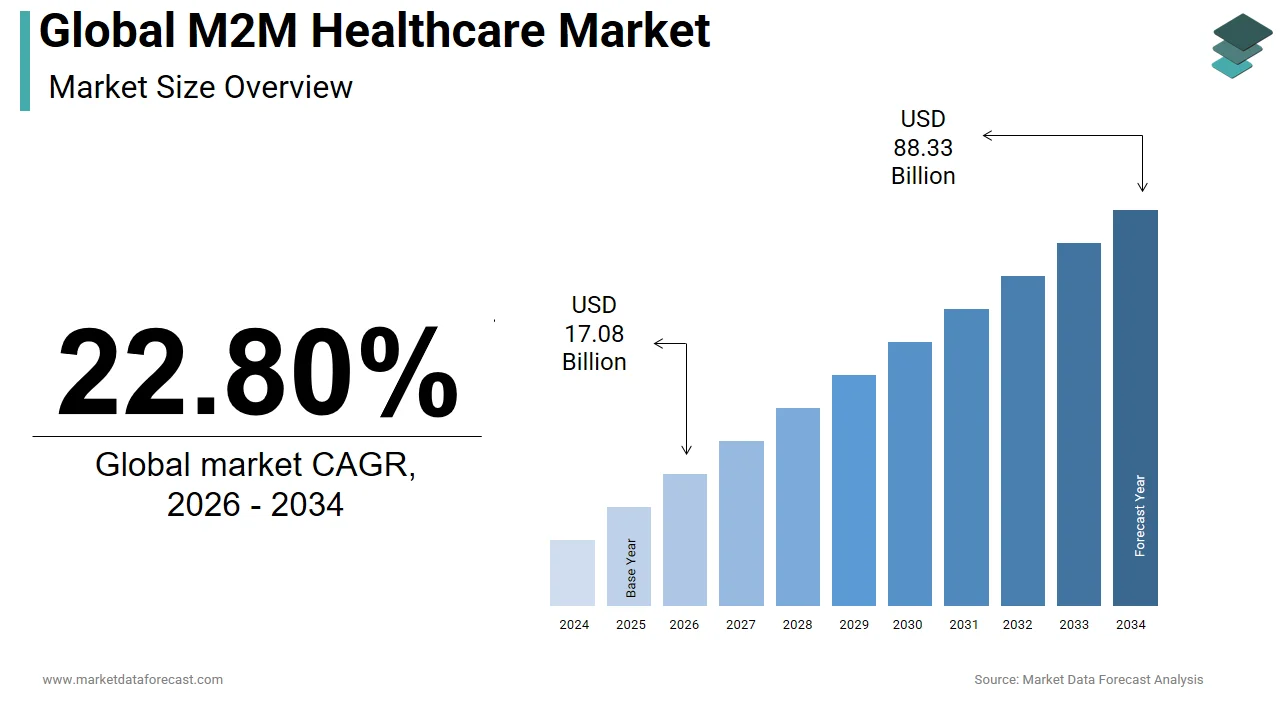
The size of the global M2M healthcare market was worth USD 13.91 billion in 2025. The global market is anticipated to grow at a CAGR of 22.80% from 2026 to 2034 and be worth USD 88.33 billion by 2034 from USD 17.08 billion in 2026.
Machine-to-Machine (M2M) technology helps connect two or more devices to transmit data without the intervention of humans. The concept of M2M involves sensors, smart meters, and other devices that collect temperature, location, and other details and transmit it to a software application through a wired or wireless network. In wired M2M communication, the data is transferred through a cable, whereas wireless communication involves cellular networks (2G,3G,4G, and 5G), Wi-Fi, and RFID (Radio Frequency Identification) to communicate. The incidence of non-communicable diseases among people is growing significantly worldwide. According to research by the WHO, non-communicable diseases are responsible for 74% of deaths worldwide. Non-communicable diseases such as cancer, diabetes, chronic respiratory diseases, and cardiovascular diseases require regular tracking. M2M technology can significantly help supervise the health condition in such situations.
Moreover, people are more health conscious after the pandemic. It is found that 70% of Americans became health conscious after COVID-19; therefore, M2M technologies have been widely used to monitor health. Hence, COVID-19 has positively impacted the M2M healthcare market.
MARKET DRIVERS
The growing patient population suffering from chronic diseases is expected to propel the M2M healthcare market growth.
According to research by the World Health Organization (WHO), an estimated 3 million people die from alcohol consumption, and 8 million die due to tobacco consumption yearly. Therefore, such an increase in alcohol consumption, tobacco use, consuming unhealthy food, and others leads to chronic or non-communicable diseases. Chronic diseases such as cancer, diabetes, chronic respiratory diseases, and cardiovascular diseases cause disability and death. According to CDC (Centers for Disease Control and Prevention), every six out of ten Americans are diagnosed with a chronic disease. In such cases, it isn't easy to manage the condition. Hence, M2M technology helps remotely monitor a patient's health. For instance, patients with diabetes can test their blood sugar levels using a glucometer. The criterion wireless module and SIM cards inside the glucometer send the test result to the telemedicine center. Because of such an increase in chronic diseases, the need for M2M technology is high, which is expected to lead to the growth of the M2M healthcare market.
The growing aging population worldwide is expected to boost the global M2M healthcare market growth.
According to the World Health Organization (WHO), an estimated 1.4 billion people worldwide are expected to be 60 years or above by 2030. The growing geriatric population results in the increasing need for medical devices as people who are aged are more likely to diagnose with various healthcare problems and require continuous health monitoring. With the rising aging population, it is found that 80% of the senior population has been affected by at least one chronic disease. Remote patient monitoring involves the safe transmission of medical data from the patient's device to the doctor's system, which helps monitor the patient's health and reduces the patient's visits to the hospital. Hence, M2M devices will also be used by the senior population. As a result, the need for connected healthcare solutions such as machine-to-machine (M2M) grows.
The increasing efforts and funding by various governments are anticipated to fuel the M2M healthcare market growth.
Considering the burden of various diseases, the governments of various countries have increased their funding and support towards the innovation of effective drugs and medical devices. The adoption of home healthcare, telemedicine, and remote patient monitoring is growing aggressively worldwide owing to the growing patient population suffering from chronic diseases such as diabetes, CVDs, cancer, and others, which is expected to result in the growing need for M2M healthcare services and boost the market growth.
In addition, the advantages associated with M2M healthcare, such as lower costs, reduced time, remote monitoring, and easier exchange of healthcare data, are further estimated to fuel the market’s growth rate. Furthermore, the rising usage of telemedicine and telehealth by people worldwide and the increasing involvement of technological developments such as AI, LM, IoT, Big Data, and Blockchain in healthcare applications are expected to promote market growth. In addition, the increasing awareness regarding the significance of electronic health records (EHR) among countries is anticipated to fuel the need for solutions for M2M healthcare.
MARKET RESTRAINTS
On the other hand, the growth of the M2M healthcare market is expected to be hampered by the lack of required healthcare infrastructure in some countries worldwide. Furthermore, the high costs associated with the maintenance of M2M healthcare and the scarcity of skilled people that can handle the operations of M2M healthcare are further estimated to inhibit the growth of the M2M healthcare market. In addition, issues associated with data security, interoperability, regulation, and compliance are anticipated to hinder the growth of the M2M healthcare market.
REPORT COVERAGE
| REPORT METRIC | DETAILS |
| Market Size Available | 2025 to 2034 |
| Base Year | 2025 |
| Forecast Period | 2026 to 2034 |
| Segments Covered | By Type, Application & Region. |
| Various Analyses Covered | Global, Regional and Country-Level Analysis, Segment-Level Analysis, Drivers, Restraints, Opportunities, Challenges; PESTLE Analysis; Porter’s Five Forces Analysis, Competitive Landscape, Analyst Overview of Investment Opportunities |
| Regions Covered | North America, Europe, Asia Pacific, Latin America, Middle East & Africa |
| Market Leaders Profiled | AirStrip Technologies, BL Healthcare, IBM, PharmaSecure, Microsoft, Apple, Ingenious Med, Cisco Networks, NeuroVigil, and QxMD Software. |
SEGMENTAL ANALYSIS
By Type Insights
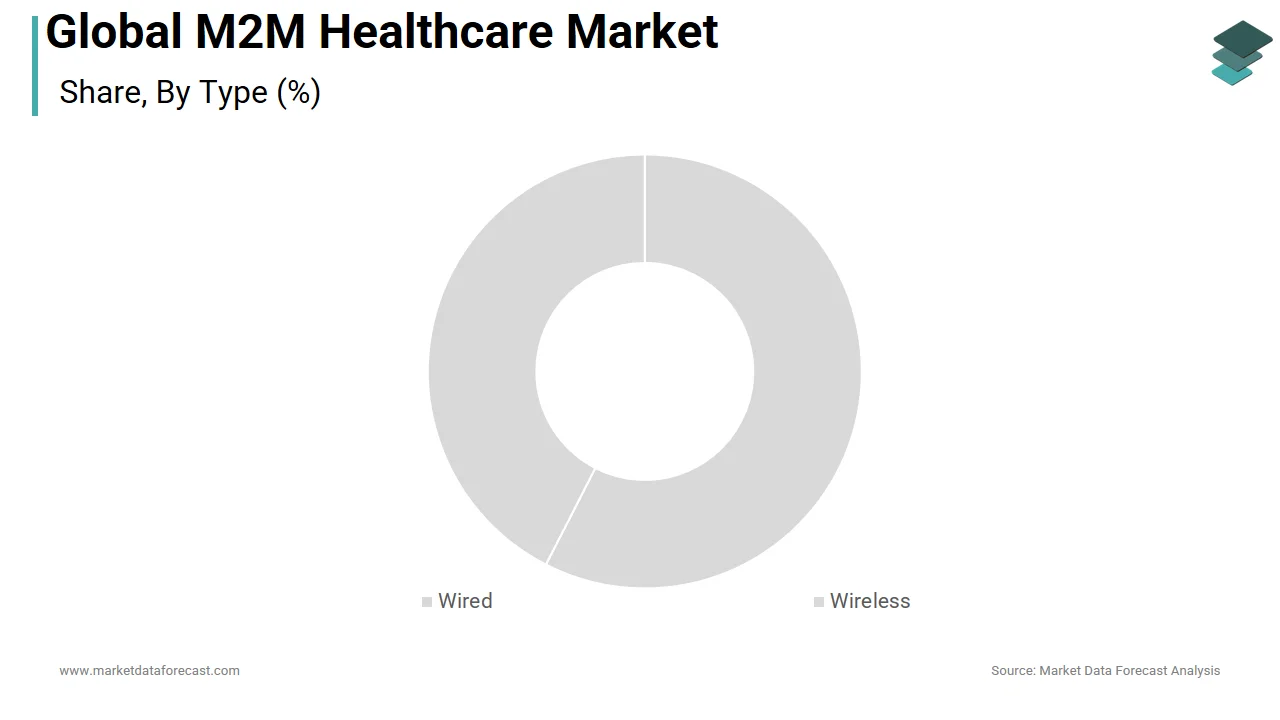
The wireless segment is expected to grow fastest during the forecast period, as the technology facilitates M2M communication and allows more healthcare applications to be connected. In addition, the adoption of short-range wireless communication technologies such as Wi-Fi, Bluetooth, and ZigBee for various applications such as in-car infotainment systems, patient monitoring devices, wireless beacons, and smart appliances are promoting segmental growth.
By Application Insights
Based on application, the remote healthcare monitoring segment held the largest share of the global M2M healthcare market in 2024. The segment’s domination is estimated to continue during the forecast period. Remote monitoring helps patients feel safe while undergoing treatment at home. It chiefly helps people with chronic diseases. The test results taken at home are safely transmitted to the physician's device. If the patient fails to take the test, the patient is reminded to take the necessary measures through remote monitoring.
By End-User Insights
Based on the end-user, the hospital segment is anticipated to hold a significant share of the global M2M healthcare market during the forecast period owing to the growing geriatric population, rising incidence of chronic diseases, and rising need for M2M technology among hospitals. Blood pressure, blood sugar level, pulse, and others are tested by the patients at home using M2M devices such as blood pressure monitors, glucometers, and oximeters. The measured data is transmitted through a wireless or wired network to the doctor's software application. Then, the healthcare management takes necessary measures to bring the patient to the hospital by ambulance and treat them accordingly.
REGIONAL ANALYSIS
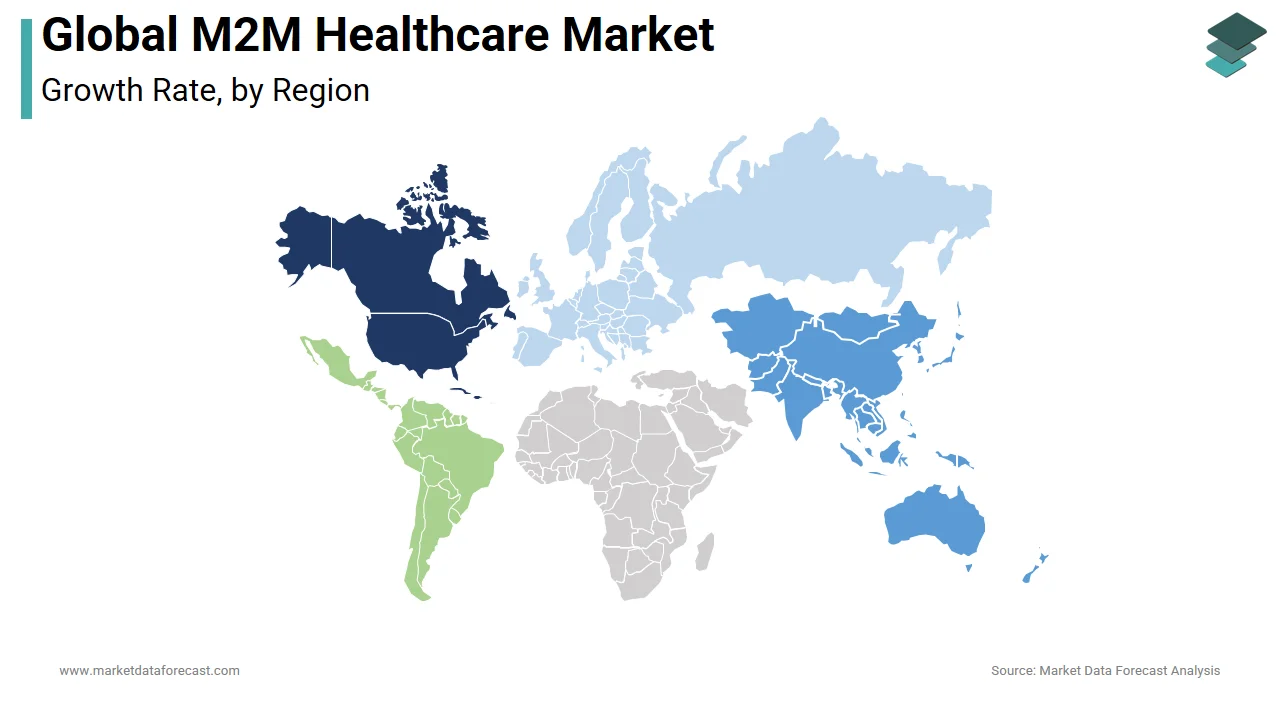
In 2024, North America captured the leading share of the worldwide M2M healthcare market, and it is predicted to continue to remain dominating during the forecast period owing to the growing investments to develop the healthcare infrastructure further and do R&D activities, rapid adoption of technological developments, and the presence of major market participants. The incidence of chronic diseases such as lung disease, stroke, heart disease, cancer, diabetes, and Alzheimer's is growing significantly among the population of the United States. According to an article published by NCBI in 2018, an estimated 133 million Americans suffer from at least one chronic disease. On the other hand, the aging population in the U.S. is also increasing rapidly. As per the U.S. Census Bureau, the aging population in the United States is 56 million, which is expected to result in a greater need for healthcare services. M2M communication monitors the patients remotely to improve patient care and reduce medical expenses. The clinical staff and doctors can remotely receive patients' data and treat them.
However, the M2M healthcare market in Europe and Asia-Pacific is on the rise owing to the growing concerns for improved healthcare systems, the rising geriatric population, and disposable incomes. In addition, as virtual systems take more prominence and digitalization the regions, especially in countries such as Germany, France, The U.K., Dutch, India, China, Japan, South Korea, and others, the scope for M2M healthcare in these countries is anticipated to grow the region. Germany and Japan are the world's technological hubs and are heavily involved in creating all types of machines, including for healthcare systems.
The European region occupied a substantial share of the worldwide market in 2024 and is predicted to grow at a healthy CAGR during the forecast period owing to the growing efforts from the European governments to promote the usage of M2M healthcare. For instance, the NHS announced plans to implement M2M healthcare in the healthcare system of the UK. In addition, the European governments' increased funding to conduct R&D and develop novel drugs and treatments is anticipated to favor regional market growth.
The Asia Pacific is expected to rise at the fastest CAGR during the forecast period owing to the growing M2M connectivity in countries such as Australia, Japan, and China. In addition, the growing support from APAC governments to promote the developments in the healthcare infrastructure and provide healthcare at an affordable cost is anticipated to boost the market growth in APAC. On the other hand, owing to the growing population in the APAC countries and the lack of promising healthcare facilities, countries such as China and India are likely to be lucrative in the APAC healthcare M2M market.
KEY MARKET PLAYERS
Companies playing a promising role in the global m2m healthcare market profiled in this report are
- AirStrip Technologies
- BL Healthcare
- IBM Corporation
- PharmaSecure
- Microsoft Corporation
- Apple Inc.
- Ingenious Med
- Cisco Systems, Inc.
- NeuroVigil
- QxMD Software Inc.
GLOBAL M2M HEALTHCARE MARKET NEWS
- In 2024, the Department of Transportation announced accepting applications for M2M company registration.
- In January 2023, Fire Boltt, an electronics company and India's most reputed smartphone company announced the invention of three new smartwatches in India. In terms of healthcare, the Fire Boltt Smartwatches help detect heart rate, blood pressure, and oxygen saturation.
- Fire Boltt launches three new smartwatches in India, all priced under Rs 3000 - India Today.
MARKET SEGMENTATION
This research report on the global M2M healthcare market has been segmented and sub-segmented into the following categories.
By Type
- Wired
- Wireless
By Application
- Remote Health Monitoring
- Clinical Monitoring
- Fitness and Wellness
By End-User
- Hospitals
- Ambulatory Surgical Centers
By Region
- North America
- Europe
- Asia Pacific
- Latin America
- The Middle East and Africa
Frequently Asked Questions
What is the global M2M healthcare market?
The global M2M healthcare market connects medical devices transmitting vital signs automatically for remote monitoring and telemedicine applications worldwide.
Why grow the global M2M healthcare market?
The global M2M healthcare market expands with chronic disease prevalence requiring continuous remote patient monitoring solutions effectively.
What drives the global M2M healthcare market?
Aging populations propel the global M2M healthcare market alongside hospital readmission reduction programs strategically.
Which applications lead the global M2M healthcare market?
Remote patient monitoring dominates the global M2M healthcare market transmitting glucose and cardiac data continuously.
What role do hospitals play in the global M2M healthcare market?
Hospitals deploy the global M2M healthcare market solutions tracking assets and monitoring discharged patients remotely.
How does telemedicine use the global M2M healthcare market?
M2M devices enable real-time consultations in the global M2M healthcare market reducing unnecessary clinic visits.
Which devices define the global M2M healthcare market?
Glucometers and blood pressure cuffs lead the global M2M healthcare market transmitting readings via cellular networks.
What challenges face the global M2M healthcare market?
Data security concerns challenge the global M2M healthcare market requiring HIPAA compliant transmission protocols.
How does chronic care fit the global M2M healthcare market?
Diabetes and heart failure patients benefit most from the global M2M healthcare market daily monitoring capabilities.
What connectivity serves the global M2M healthcare market?
LTE-M and NB-IoT networks power the global M2M healthcare market low-power medical device communications reliably.
Related Reports
Access the study in MULTIPLE FORMATS
Purchase options starting from
$ 2500
Didn’t find what you’re looking for?
TALK TO OUR ANALYST TEAM
Need something within your budget?
NO WORRIES! WE GOT YOU COVERED!
Call us on: +1 888 702 9696 (U.S Toll Free)
Write to us: sales@marketdataforecast.com