- Product Description Description
- Table of Contents TOC
- List of Table & Figure LOT
- Get Free Sample PDF Sample PDF
Market Size, 2025
$3.53 BnMarket Estimate, 2026
$3.82 BnMarket Forecast, 2034
$7.12 BnCAGR, 2026–2034
8.1%Global Dairy Blends Market Size, Growth, Trends & Forecast (2026–2034)
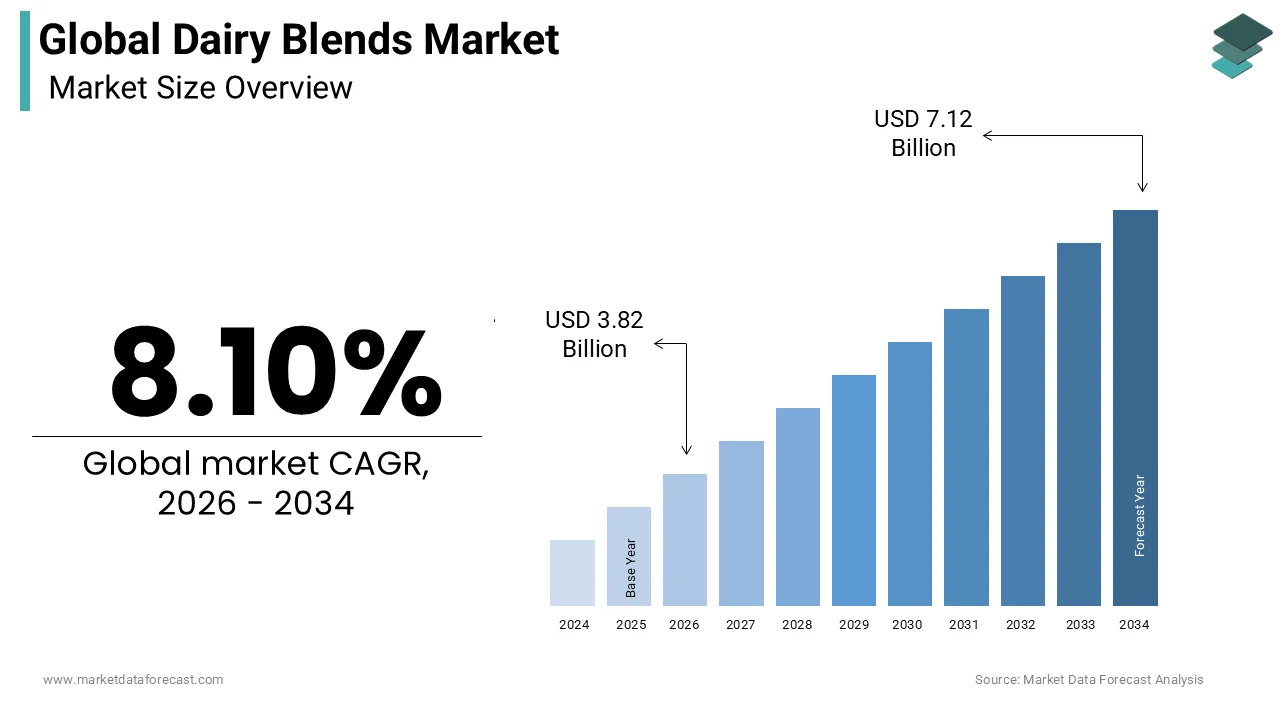
The global dairy blends market size was calculated to be USD 3.53 billion in 2025, is anticipated to be worth USD 3.82 billion in 2026, and is projected to scale up to USD 7.12 billion by 2034, registering a compound annual growth rate (CAGR) of 8.10% during the forecast period from 2026 to 2034. Driven by cost optimization needs in volatile commodity markets, nutritional fortification requirements, and expanding industrial applications across infant nutrition and beverage sectors, the market continues to experience robust global expansion.
Key Executive Metrics (At-a-Glance)
- 2025 Base Valuation: USD 3.53 Billion
- 2026 Current Valuation: USD 3.82 Billion
- 2034 Forecast Valuation: USD 7.12 Billion
- Compound Annual Growth Rate (CAGR): 8.10% (2026–2034)
- Dominant Type Segment: Dairy/non-dairy ingredients segment (held the largest market share in 2025 due to production cost optimization)
- Fastest-Growing Type Segment: Dairy as a functional ingredient segment (estimated to witness the fastest CAGR driven by clean-label demands)
- Dominant Form Segment: Powder segment (accounted for the leading share in 2025 owing to extended shelf life and logistics efficiency)
- Fastest-Growing Form Segment: Liquid segment (predicted to register a promising CAGR driven by foodservice convenience and premiumization trends)
- Dominant Application Segment: Infant formula segment (held the dominant share in 2025 due to strict nutritional and regulatory standards)
- Fastest-Growing Application Segment: Beverages segment (expected to register the fastest CAGR driven by ready-to-drink and functional beverage surges)
- Regional Leader: Europe & Asia Pacific (Europe holds a substantial share anchored by high-quality production and exports, while Asia Pacific experiences rapid expansion due to rising disposable incomes and price sensitivity)
Core Market Drivers
- Cost Optimization Strategies: Manufacturers use dairy blends to mitigate price swings in pure dairy ingredients, reducing overall ingredient expenditures by 15% to 25% through vegetable oil substitution.
- Nutritional Fortification Capabilities: Dairy blends serve as scalable food-based interventions to address micronutrient deficiencies, acting as effective carriers for fat-soluble vitamins (A, D, E, and K) in global programs.
Primary Market Restraints & Challenges
- Stringent Labeling Regulations: Strict standards of identity protect dairy designations, forcing blends into technical terms (such as fat-filled milk powder) that lack consumer appeal and marketing ease.
- Technical & Functional Limitations: Replacing milk fat with vegetable oils can alter melting, crystallization, and flavor release properties, leading to textural defects in specialized applications.
- Supply Chain Vulnerabilities: Key inputs like palm and sunflower oils are geographically concentrated, exposing supply chains to geopolitical and climate-induced agricultural shocks.
Global Dairy Blends Market Segmentation Breakdown
| Segment Category | Leading Sub-Segment (2025 Base) | Fastest-Growing Sub-Segment (2026–2034) |
|---|---|---|
| By Type | Dairy/non-dairy ingredients (dominant share due to significant production cost reductions) | Dairy as a functional ingredient (fastest CAGR driven by clean-label trends) |
| By Form | Powder (leading share attributed to extended shelf life up to 24 months and logistics efficiency) | Liquid (fastest growth driven by foodservice convenience and premiumization) |
| By Application | Infant formula (dominant share governed by strict nutritional requirements and human milk replication) | Beverages (fastest CAGR driven by ready-to-drink coffee, tea, and functional RTD options) |
| By Region | Europe & North America (substantial market shares backed by mature industries and strict safety standards) | Asia-Pacific (rapid expansion fueled by urbanization, rising disposable incomes, and reliance on imports) |
Major Industry Players Profiled
Key market participants shaping the global dairy blends landscape include Anchor, Agri-Mark, Dohler GMB, Agropur Cooperative, Fonterra Cooperative, Koninklijke Buisman B.V, Advanced Food Products, Hormel Foods Corp, and All American Foods Inc.
 Download Free Sample Report
Global Dairy Blends Market Size
The size of the global dairy blends market was expected to be worth USD 3.53 billion in 2025 and is anticipated to be worth USD 7.12 billion by 2034 from USD 3.82 billion in 2026, growing at a CAGR of 8.10% during the forecast period.
Dairy blends are formulated products that combine dairy ingredients, such as milk powder, butterfat, or whey, with vegetable fats, proteins, or other non-dairy components to achieve specific functional, nutritional, and economic characteristics. These blends are extensively utilized across infant nutrition, bakery, confectionery, and processed food sectors, where pure dairy is either cost-prohibitive or functionally inadequate for certain applications. The sector is intrinsically linked to global dairy production dynamics and the strategic need for ingredient optimization in food manufacturing. According to the Food and Agriculture Organization, global milk production reached 930 million tonnes in 2023, providing the essential raw material base for this industry. In developing regions, price sensitivity drives significant adoption, as dairy blends offer a more affordable alternative to whole milk powder without compromising critical nutritional benchmarks. The European Commission notes that specialized fat-filled milk powders constitute a vital export category, supporting food security in import-dependent nations. Regulatory frameworks strictly govern labeling and composition to prevent adulteration and ensure consumer safety, particularly in sensitive categories like infant formula. Technological advancements in emulsification and spray drying have enhanced the solubility and stability of these complex matrices, making them indispensable in industrial food processing. As supply chains face volatility and manufacturers seek resilient sourcing strategies, dairy blends serve as a crucial buffer against raw material fluctuations while maintaining product consistency and quality standards globally.
MARKET DRIVERS
Cost Optimization Strategies in Volatile Commodity Markets Drive Adoption
Manufacturers increasingly utilize dairy blends as a strategic tool to manage input costs amidst persistent volatility in global dairy commodity prices, which is a key factor driving the global dairy blends market forward. Pure dairy ingredients, like skimmed milk powder and anhydrous milk fat, are subject to dramatic price swings influenced by weather, feed costs, and geopolitical trade policies. According to the International Farm Comparison Network, the farm gate milk price in major exporting regions fluctuated by over 40% between 2022 and 2023, creating severe margin pressure for food processors. Dairy blends allow formulators to replace expensive dairy fat with stable vegetable oils, such as palm or coconut oil, reducing overall ingredient expenditure by 15% to 25%, depending on the formulation ratio. This economic advantage is particularly critical in high-volume, low-margin segments, like recombined milk and bakery shortenings, where even marginal savings translate to substantial annual benefits. In Southeast Asia, where imported dairy tariffs can exceed 10%, locally produced or regionally sourced blends provide a competitive pricing structure that pure imports cannot match. The ability to lock in long-term contracts for vegetable fats while maintaining a consistent dairy protein profile offers financial predictability that pure dairy supply chains lack. Consequently, procurement teams prioritize blended solutions to stabilize balance sheets and protect retail price points from inflationary shocks, ensuring sustained demand for these hybrid ingredients across diverse industrial applications.
Nutritional Fortification Capabilities in Emerging Economies Fuel Demand
Many developing nations face dual burdens of malnutrition, where caloric sufficiency exists alongside widespread vitamin and mineral gaps, which is further aiding the expansion of the global dairy blends market. The World Health Organization estimates that over 2 billion people globally suffer from micronutrient deficiencies, necessitating scalable, food-based interventions. Dairy blends are uniquely suited for this purpose because their fat matrix enhances the bioavailability of fat-soluble vitamins A, D, E, and K, which are often added during processing. According to UNICEF supply data, in West Africa, fortified fat-filled milk powders have become staples in school feeding programs, reaching millions of children annually. Governments and NGOs prefer these blends over pure dairy due to lower logistics costs and extended shelf life in tropical climates where cold chain infrastructure is limited. The standardized composition of industrial blends ensures precise nutrient delivery, unlike variable traditional dairy sources. Furthermore, local regulations in countries like Nigeria and Indonesia mandate fortification of certain food categories, creating a guaranteed market for compliant blend manufacturers. This public health imperative transforms dairy blends from mere commercial substitutes into essential tools for national nutrition security, driving consistent government and institutional procurement independent of consumer discretionary spending cycles.
MARKET RESTRAINTS
Stringent Labeling Regulations and Consumer Perception Hinder Growth
Regulatory complexity surrounding the definition and labeling of dairy blends creates significant barriers to market expansion and consumer acceptance. Many jurisdictions maintain strict standards of identity for dairy products, prohibiting the use of terms like milk or cream for items containing vegetable fats unless explicitly qualified. The Codex Alimentarius establishes international guidelines, but national implementations vary widely, causing compliance headaches for multinational manufacturers. In the European Union, Regulation 1308/2013 strictly protects dairy designations, forcing blends to be labeled as fat-filled milk powder or similar technical terms that lack consumer appeal. This regulatory friction extends to marketing claims, where health benefits associated with dairy may not be transferable to blended products despite similar nutritional profiles. Consumer advocacy groups frequently campaign against what they perceive as inferior substitutes, further stigmatizing the category. According to the European Consumer Organisation, 65% of respondents viewed vegetable fat dairy alternatives as less healthy than pure dairy, regardless of actual nutrient content. This perception gap forces manufacturers to invest heavily in education and reformulation to meet clean label expectations. Additionally, varying import tariffs and customs classifications for blends versus pure dairy create unpredictable landed costs. Navigating this fragmented regulatory landscape requires dedicated legal resources and slows product innovation cycles, particularly for smaller players lacking global compliance infrastructure, thereby restraining broader market penetration.
Technical Limitations in Functional Performance Restrict Applications
Despite advances in food science, dairy blends still face inherent technical limitations compared to pure dairy ingredients in specific high-performance applications, which further hinders global market growth. The replacement of milk fat with vegetable oils alters the melting, crystallization, and flavor release properties that are intrinsic to authentic dairy functionality. In premium chocolate manufacturing, for instance, cocoa butter equivalents derived from vegetable fats cannot fully replicate the complex polymorphic behavior of milk fat, leading to textural defects or bloom issues. The Journal of Dairy Science reports that fat-filled milk powders exhibit reduced foaming capacity and heat stability in UHT processing compared to whole milk powder, limiting their use in barista-grade coffee creamers and sterilized beverages. Emulsion instability remains a challenge in acidic environments, where vegetable fat droplets may coalesce, causing separation in yogurt drinks or fermented products. These functional gaps force manufacturers to add expensive stabilizers or processing aids, which negates some cost advantages and complicates clean label positioning. In infant nutrition, the fatty acid profile of vegetable blends differs significantly from human milk or bovine milk fat, affecting lipid absorption and metabolic outcomes, requiring extensive clinical validation. Consequently, many premium brands avoid blends entirely to preserve sensory quality and brand integrity. Until encapsulation and fractionation technologies advance sufficiently to mimic native dairy structures perfectly, these performance constraints will continue to cap the addressable market for dairy blends in high-value segments.
MARKET OPPORTUNITIES
Expansion into Plant-Forward Hybrid Products Creates New Avenues
The rising consumer interest in flexitarian diets presents a significant opportunity for dairy blends positioned as transitional or hybrid products rather than pure substitutes. Unlike fully plant-based alternatives that often struggle with taste and texture, dairy blends retain enough animal-derived components to satisfy sensory expectations while reducing environmental footprint. Market research firm Innova Market Insights identified hybrid products as a top trend, noting that 40% of consumers actively seek foods combining plant and animal ingredients for balanced nutrition and sustainability. Manufacturers can leverage this trend by formulating blends with higher proportions of sustainable vegetable fats and reduced dairy content, marketed explicitly as lower-carbon options. According to data from the International Dairy Federation, life cycle assessments indicate that replacing 30% of dairy fat with vegetable oil can reduce greenhouse gas emissions by up to 20%. This environmental benefit resonates with eco-conscious consumers who are unwilling to compromise on taste. Retailers are increasingly allocating shelf space to such hybrid SKUs as they bridge the gap between traditional dairy and niche plant-based categories. Furthermore, regulatory bodies in some regions are beginning to recognize hybrid products as distinct categories, enabling clearer labeling and marketing claims. By embracing this middle ground, dairy blend producers can capture growth from both conventional dairy users migrating toward sustainability and plant-based consumers seeking improved sensory experiences.
Innovation in Specialized Medical and Clinical Nutrition Segments
Medical and clinical nutrition represents an underpenetrated, high-value opportunity for tailored dairy blend formulations. Patients with specific metabolic disorders, renal disease, or malabsorption syndromes require precise nutrient compositions that standard dairy or generic blends cannot provide. According to Grand View Research, the global clinical nutrition market is projected to reach 75 billion USD, driven by aging populations and chronic disease prevalence. Dairy blends allow nutritionists to customize fat sources, protein ratios, and carbohydrate types to meet exact therapeutic requirements. For example, ketogenic diets for epilepsy management require high-fat, low-carbohydrate blends that maintain palatability through careful emulsification of medium-chain triglycerides with dairy proteins. Enteral feeding formulas also rely on stable blended matrices to prevent tube clogging and ensure consistent nutrient delivery. Unlike consumer markets, clinical buyers prioritize efficacy and tolerability over cost, making them less sensitive to raw material price fluctuations. Regulatory pathways for medical foods, although rigorous, offer longer exclusivity periods and higher margins once approved. Partnerships with healthcare institutions and clinical researchers enable manufacturers to develop evidence-based formulations backed by peer-reviewed studies. As personalized nutrition gains traction, the demand for modular blend ingredients that can be customized at point of care will expand, offering dairy blend producers a defensible niche insulated from commodity competition.
MARKET CHALLENGES
Supply Chain Vulnerability to Geopolitical and Climate Shocks
Dairy blends remain acutely vulnerable to supply chain disruptions stemming from geopolitical conflicts and climate-induced agricultural failures, despite their intended role as risk-mitigation tools, which is a significant challenge to the dairy blends market growth. Key vegetable oil inputs, like palm and sunflower oil, are geographically concentrated, with Indonesia, Malaysia, and Ukraine accounting for over 80% of global exports, respectively. According to the World Bank, the Russia-Ukraine conflict caused sunflower oil prices to spike by 40% in 2022, demonstrating how quickly blend economics can deteriorate. Similarly, El Niño events in Southeast Asia regularly suppress palm yields, triggering cascading price increases across all fat-filled dairy products. Unlike diversified dairy sourcing, which spans multiple continents, vegetable oil supply chains lack redundancy, making them susceptible to single-point failures. Logistics bottlenecks in critical shipping lanes like the Red Sea or Panama Canal further exacerbate delays and freight costs for both dairy and vegetable components simultaneously. Manufacturers operating on thin margins find themselves unable to absorb these shocks or pass them on to price-sensitive customers in emerging markets. Inventory buffering provides only temporary relief given the perishable nature of some blend components. Diversifying oil sources to include shea, illipe, or rice bran requires significant reformulation and regulatory reapproval, slowing response times. Until supply chains become more resilient through geographic diversification and strategic stockpiling, dairy blend producers will remain exposed to external volatility that undermines their core value proposition of stability.
Intensifying Competition from Advanced Plant-Based Alternatives
The rapid maturation of plant-based dairy alternatives poses a formidable competitive threat to traditional dairy blends, particularly in mid-tier applications. Next-generation plant proteins from pea, fava bean, and potato now offer functional properties previously exclusive to dairy, including gelation, foaming, and emulsification, without requiring animal-derived components. The Plant-Based Foods Association reports that plant-based milk sales in the United States reached 2.9 billion USD in 2023, capturing share from both fluid milk and recombined dairy products. Fermentation-derived precision dairy proteins produced by companies like Perfect Day and Remilk are molecularly identical to whey and casein yet completely animal-free, enabling true dairy functionality without livestock. These innovations directly target the functional gaps that historically protected dairy blends in processed foods. Price parity is approaching rapidly, with some plant-based ingredients already cheaper than dairy blends when accounting for total cost of ownership, including allergen management and labeling flexibility. Consumers increasingly perceive plant-based options as cleaner and more ethical than hybrid dairy-vegetable formulations, viewing blends as outdated transitional products rather than innovative solutions. Retailers and foodservice operators are consolidating SKUs, favoring fully plant-based lines to simplify operations and align with sustainability targets. Unless dairy blend manufacturers can differentiate through superior nutrition, cost, or regulatory status, they risk being displaced in core industrial applications by technologically advanced plant-based competitors.
REPORT COVERAGE
| REPORT METRIC | DETAILS |
| Market Size Available | 2025 to 2034 |
| Base Year | 2025 |
| Forecast Period | 2026 to 2034 |
| CAGR | 8.10% |
| Segments Covered | By Type, Form, Application, and Region |
| Various Analyses Covered | Global, Regional & Country Level Analysis; Segment-Level Analysis, DROC, PESTLE Analysis, Porter’s Five Forces Analysis, Competitive Landscape, Analyst Overview of Investment Opportunities |
| Regions Covered | North America, Europe, APAC, Latin America, Middle East & Africa |
| Market Leaders Profiled | Anchor, Agri-Mark, Dohler GMB, Agropur Cooperative, Fonterra Cooperative, Koninklijke Buisman B.V, Advanced Food Products, Hormel Foods Corp, All American Foods Inc and Others. |
SEGMENTAL ANALYSIS
By Type Insights
The dairy/non-dairy ingredients segment led the market with the largest share of the global market in 2025 due to its ability to significantly reduce production costs through the partial substitution of expensive dairy fats with vegetable oils. Manufacturers utilize this blend type to mitigate the impact of volatile global milk prices while maintaining acceptable sensory and nutritional profiles. According to the International Farm Comparison Network, farm gate milk prices fluctuated by over 40% between 2022 and 2023, creating severe margin pressure for food processors who rely on pure dairy inputs. According to industry analysis from Food Processing Magazine, by replacing up to 50% of milk fat with palm or coconut oil, producers can lower ingredient costs by 15% to 25%. This economic advantage is particularly critical in high-volume applications, such as recombined milk, bakery shortenings, and confectionery fillings, where price sensitivity is high. In emerging markets like India and Indonesia, import tariffs on pure dairy products can exceed 10%, making locally sourced or regionally blended alternatives more competitive. The standardized availability of vegetable oils ensures consistent supply chain stability compared to seasonal dairy variations. Procurement teams prioritize these blends to stabilize balance sheets and protect retail price points from inflationary shocks. The ability to lock in long-term contracts for vegetable fats while maintaining a consistent protein profile offers financial predictability that pure dairy supply chains lack, ensuring sustained demand for this segment across diverse industrial applications.
On the other hand, the dairy as a functional ingredient segment is estimated to witness the fastest CAGR in the global market over the forecast period owing to the rising consumer demand for clean-label products that offer natural functionality without artificial additives. Consumers are actively seeking ingredients that provide texture, stability, emulsification, and nutritional benefits while being recognizable and perceived as natural. Dairy proteins, such as whey and casein, are increasingly used for their inherent functional properties rather than just as bulk ingredients. For instance, 45% of global consumers prefer products with simple and recognizable ingredient lists, driving manufacturers to replace synthetic stabilizers with dairy-based alternatives. Whey protein isolates, for example, are utilized for their superior foaming and gelling capabilities in sports nutrition and bakery applications. According to Grand View Research, the global market for functional dairy ingredients is projected to grow at a compound annual growth rate of 7.2% through 2030. This growth is fueled by the health and wellness trend, where dairy is valued for its high biological value and essential amino acid profile. Manufacturers are investing in advanced filtration technologies to produce high-purity functional dairy ingredients that meet clean-label standards. These ingredients allow for the reduction of added sugars and fats while maintaining product quality, appealing to health-conscious buyers. The shift toward minimal processing and natural formulation supports the rapid expansion of this segment as brands seek to differentiate themselves through transparency and nutritional integrity.
By Form Insights
The powder segment accounted for the leading share of the global market in 2025. The dominance of the powder segment in the global market is attributed to its extended shelf life and superior logistics efficiency compared to liquid or spreadable forms. The removal of water through spray drying significantly reduces weight and volume, lowering transportation and storage costs. According to the United States Department of Agriculture, powdered dairy products have a shelf life of up to 24 months when stored properly, whereas liquid alternatives typically last only a few weeks. This longevity is crucial for exporters and distributors operating in regions with limited cold chain infrastructure, such as parts of Africa and Southeast Asia. According to the Food and Agriculture Organization, powdered milk and blends are vital for food security programs in remote areas where refrigeration is unavailable. Manufacturers prefer powder for its ease of handling and integration into dry mixing processes for bakery and confectionery applications. The ability to stockpile large quantities without spoilage risk provides supply chain resilience against disruptions. In emerging markets where price sensitivity is high, powdered blends offer an affordable way to add dairy nutrition to diets without the premium cost of refrigerated products. The versatility of powder in reconstitution allows for flexible usage in both industrial and household settings. These practical advantages ensure that powder remains the dominant form in the global dairy blends market.
However, the liquid segment is the fastest-growing segment and is predicted to register a promising CAGR in the global market during the forecast period owing to the premiumization trends and the demand for convenience in the food service industry. Restaurants, cafes, and hotels prefer liquid formats for their ease of use and consistency in high-volume operations. Liquid blends eliminate the need for reconstitution, saving time and labor costs while ensuring uniform quality in every serving. According to Statista, the global food service market is projected to grow at a compound annual growth rate of 5.5% through 2030, driving demand for ready-to-use ingredients. Liquid dairy blends are particularly popular in coffee shops for creating lattes and cappuccinos, where foam quality and texture are paramount. Baristas value liquid blends for their ability to steam and froth consistently without clumping. In the retail sector, liquid creamers and drinking yogurts made from dairy blends are gaining popularity among busy consumers seeking quick, nutritious options. The perception of liquid products as fresher and more premium than powders appeals to urban shoppers. Advances in aseptic packaging have extended the shelf life of liquid blends, making them viable for wider distribution. This combination of operational efficiency and consumer preference for convenience fuels the rapid growth of the liquid segment.
By Application Insights
The infant formula segment held the dominant share of the global market in 2025. The growth of the infant formula segment in the global market can be credited to the strict nutritional requirements and regulatory standards governing baby food production. Dairy blends are essential in formulating infant formula to closely mimic the composition of human milk, particularly in terms of fat content and fatty acid profile. The World Health Organization recommends breastfeeding but acknowledges that formula is a necessary alternative for millions of infants globally, requiring precise nutritional replication. Dairy blends allow manufacturers to incorporate specific vegetable oils rich in linoleic and alpha-linolenic acids alongside dairy proteins to meet these stringent guidelines. According to UNICEF, approximately 30% of infants worldwide are fed with formula, creating a massive and stable demand base. The European Commission Regulation on infant formula mandates specific levels of essential nutrients, which dairy blends help achieve consistently. The high barrier to entry and rigorous quality control measures ensure that only established players with advanced blending technologies can participate in this segment. Parents prioritize safety and nutritional adequacy over cost, making this segment less price-sensitive and more focused on quality assurance. The consistent growth in birth rates in emerging economies further sustains demand. Additionally, the trend toward specialized formulas for premature infants or those with allergies drives innovation in tailored dairy blend compositions. This critical application ensures that infant formula remains the dominant consumer of high-quality dairy blends globally.
However, the beverages segment is expected to register the fastest CAGR in the global market during the forecast period owing to the surge in ready-to-drink (RTD) products and functional beverages. Consumers are increasingly seeking convenient, nutritious, and tasty beverage options that fit into busy lifestyles. Dairy blends are used extensively in RTD coffee, tea, smoothies, and protein shakes to provide creaminess and stability without the logistical challenges of fresh milk. According to Euromonitor International, the global RTD coffee market grew by 11%, reflecting strong consumer preference for on-the-go consumption. Dairy blends offer extended shelf life and resistance to heat treatment, making them ideal for ambient storage and distribution. In the functional beverage space, dairy proteins are blended with vitamins, minerals, and botanical extracts to create health-focused drinks targeting energy, immunity, and recovery. The Plant-Based Foods Association reports that hybrid dairy-plant beverages are gaining traction as they offer better taste and texture than purely plant-based options. This innovation drives demand for specialized dairy blends that can integrate seamlessly with plant ingredients. The convenience factor combined with nutritional benefits appeals to millennials and Gen Z consumers who prioritize both health and ease. As urbanization increases the demand for portable nutrition solutions, the beverage segment continues to expand rapidly, capturing new usage occasions and driving growth for dairy blend manufacturers.
REGIONAL ANALYSIS
Asia Pacific Dairy Blends Market Analysis
Asia Pacific is anticipated to experience rapid expansion over the next few years, fueled by rising disposable incomes, urbanization, and expanding retail channels. China, India, and Southeast Asian nations are major contributors due to high demand for affordable dairy alternatives. According to the Food and Agriculture Organization, milk consumption in Asia is rising, but local production cannot meet demand, creating reliance on imports and blends. Dairy blends are widely used in tea, coffee, and bakery products, which are staples in many Asian cultures. The region is price-sensitive, favoring cost-effective powdered blends over premium liquid formats. Government initiatives to improve nutrition through fortified foods drive institutional demand for dairy blends. Urbanization and the expansion of modern retail channels increase access to packaged dairy products. Local manufacturers are investing in capacity to reduce dependence on imports. The growing middle class is beginning to explore premium and functional dairy blends. E-commerce platforms facilitate the distribution of diverse dairy products to remote areas. The region offers significant untapped potential for future growth as dietary habits evolve. Strategic partnerships between global and local companies enhance market penetration.
Europe Dairy Blends Market Analysis
Europe had a substantial share of the global market in 2025 and is expected to witness steady performance in the coming years, driven by strict regulatory standards and a growing focus on sustainability and hybrid products. The European Union Regulation 1308/2013 strictly protects dairy designations, impacting how blends are marketed and sold. Countries like Germany, France, and the Netherlands are key producers and exporters of dairy blends, particularly fat-filled milk powders. According to the European Commission, exports of dairy blends to Africa and Asia are vital for balancing regional milk surpluses. The region sees strong demand for high-quality infant formula ingredients driven by stringent safety standards. Consumer skepticism toward vegetable fat substitutes limits domestic consumption of lower-quality blends. However, there is growing interest in sustainable and hybrid products that reduce environmental impact. The Common Agricultural Policy supports dairy farmers, influencing raw material availability and pricing. Innovation focuses on functional ingredients and clean-label solutions to meet consumer expectations. The mature market status drives competition through differentiation and value addition. Trade agreements facilitate the export of European dairy blends to emerging markets. The region remains a leader in dairy technology and quality assurance, setting global benchmarks.
North America Dairy Blends Market Analysis
North America held a notable share of the global market in 2025 and is likely to maintain steady growth over the next few years due to high consumer awareness of nutritional labels and stable demand in processed foods and infant nutrition. The region is characterized by a mature dairy industry and high consumer awareness of nutritional labels. The United States is the primary driver, with a strong demand for specialized ingredients in processed foods and infant nutrition. According to the US Department of Agriculture, domestic milk production remains stable, supporting the availability of raw materials for blending. However, strict labeling regulations under the FDA restrict the use of dairy terms for blends containing vegetable fats, influencing product positioning. The trend toward clean-label and organic products is prominent, driving innovation in natural dairy blends. Food service operators in North America increasingly adopt liquid dairy blends for efficiency and consistency. The presence of major multinational ingredient suppliers fosters competition and technological advancement. Consumer preference for convenience drives demand for ready-to-use liquid formats. Despite the maturity of the market, growth is sustained by innovation in functional ingredients and hybrid products. The region serves as a hub for research and development in dairy technology, influencing global trends. Regulatory clarity and strong infrastructure support the efficient distribution of dairy blends across the continent.
Latin America Dairy Blends Market Analysis
Latin America is projected to grow moderately over the coming years, supported by economic recovery and middle-class expansion driving processed food consumption. The region has a strong dairy tradition, but economic volatility affects purchasing power. Dairy blends are popular in bakery and confectionery industries due to their cost-effectiveness. According to the Inter-American Development Bank, middle-class growth is driving demand for processed foods containing dairy blends. Urbanization is increasing consumption of ready-to-eat and drink products. Local producers compete with imports by offering affordable blended options. The region faces challenges related to supply chain infrastructure and regulatory consistency. However, there is growing interest in fortified dairy blends to address nutritional deficiencies. Coffee culture in countries like Colombia and Brazil drives demand for creamers and blends. The market is evolving with increasing awareness of health and wellness trends. Retail expansion in urban centers improves access to diverse dairy products. Economic recovery efforts support gradual market expansion. The region presents opportunities for growth as stability improves and consumption patterns shift.
Middle East and Dairy Blends Market Analysis
The Middle East and Africa are likely to see steady adoption over the next few years, driven by government nutrition initiatives and expanding urbanization. The Gulf Cooperation Council countries drive demand due to high income levels and reliance on food imports. Saudi Arabia and the United Arab Emirates are key markets for premium dairy blends. According to the World Bank, urbanization rates are increasing in Africa, expanding the consumer base for affordable dairy products. Dairy blends are essential for food security programs in sub-Saharan Africa, where local milk production is low. Imported fat-filled milk powders are staples in many African households due to their long shelf life and affordability. Religious dietary laws influence ingredient choices, favoring halal-certified products. Limited cold chain infrastructure restricts the adoption of liquid blends, favoring powdered formats. The region sees potential for growth as infrastructure improves and local processing capacity expands. Investment in local manufacturing could reduce costs and increase accessibility. The market is nascent but offers long-term opportunities for dairy blend suppliers. Government initiatives to improve nutrition support demand for fortified blends.
COMPETITION OVERVIEW
The competition in the dairy blends market is characterized by a mix of large multinational dairy cooperatives and specialized ingredient suppliers vying for dominance in industrial applications. Established giants leverage economies of scale and extensive distribution networks to serve global food manufacturers, while niche players differentiate through specialized functional blends and clean label innovations. Price competition remains intense in commodity segments such as fat-filled milk powders, prompting manufacturers to focus on value-added services and technical support. Regulatory compliance regarding labeling and composition standards creates barriers to entry but also drives standardization across the industry. Innovation in texture enhancement and nutritional fortification serves as a primary battleground as companies strive to meet the demands of health-conscious consumers and food formulators. Brand loyalty is built through consistent quality, reliability, and collaborative product development with key accounts. The shift toward sustainable and hybrid products pressures competitors to adapt quickly or risk losing market relevance. Collaborative relationships with food service providers and retailers are essential for securing long-term contracts. This dynamic environment requires continuous investment in research and agile supply chain management to maintain competitive advantage.
KEY MARKET PLAYERS
A few major key players in the global dairy blends market include
- Anchor
- Agri-Mark
- Dohler GMB
- Agropur Cooperative
- Fonterra Cooperative
- Koninklije viv Buisman B.V
- Advanced Food Products
- Hormel Foods Corp
- All American Foods Inc
- Others
Top Strategies Used by Key Market Participants
Key players in the dairy blends market prioritize product innovation to develop clean label and sustainable formulations that meet evolving consumer preferences. Companies invest in research and development to create hybrid blends combining dairy proteins with plant-based fats for improved functionality and environmental benefits. Strategic partnerships with agricultural suppliers ensure stable sourcing of raw materials and reduce supply chain risks. Expansion into emerging markets through local manufacturing facilities helps companies cater to regional tastes and reduce logistics costs. Digital marketing and technical support services are utilized to build brand loyalty and educate customers about the benefits of specialized blends. Mergers and acquisitions allow firms to acquire specialized technologies and broaden their product portfolios. Sustainability initiatives, including carbon footprint reduction and ethical sourcing, are central to corporate strategies to align with regulatory expectations and consumer values.
Leading Players in the Market
- Fonterra Co-operative Group Limited is a global leader in dairy ingredients, providing high-quality dairy blends for infant nutrition and food service applications. The company leverages its vast milk supply in New Zealand to produce consistent fat-filled milk powders and specialized blends. In February 2024, Fonterra launched a new range of sustainable dairy vegetable oil blends designed to reduce carbon footprints while maintaining nutritional value. This initiative aligns with global sustainability goals and appeals to eco-conscious manufacturers. Fonterra invests heavily in research to optimize emulsion stability and solubility in their blend formulations. Their strong distribution network ensures reliable supply to emerging markets in Asia and Africa. These actions reinforce their position as a trusted partner for large-scale food processors seeking cost-effective and nutritious dairy solutions.
- Arla Foods Ingredients contributes significantly to the dairy blends market through its advanced membrane filtration technologies and expertise in protein standardization. The company supplies specialized dairy blends that enhance texture and nutritional profiles in bakery and beverage applications. In January 2024, Arla expanded its production capacity in Denmark to meet rising demand for functional dairy ingredients used in hybrid products. This expansion supports their strategy to provide customized solutions for clean label formulations. Arla focuses on developing blends that improve mouthfeel inplant-basedd alternatives, bridging the gap between dairy and non-dairy sectors. Their technical service teams work closely with customers to optimize formulation efficiency. These efforts strengthen their reputation for innovation and quality in the competitive global dairy ingredients landscape.
- DMK Group plays a vital role in the dairy blends market by offering a diverse portfolio of milk powder and fat-filled dairy products. The company serves both industrial clients and retail consumers with high-quality blended ingredients suitable for confectionery and bakery uses. In November 2023, DMK introduced a new line of organic dairy blends targeting the premium health food segment in Europe. This launch addresses growing consumer preference for organic and sustainably sourced ingredients. DMK utilizes its extensive European milk collection network to ensure raw material quality and traceability. The company actively participates in industry forums to showcase advancements in blending technology. These strategic initiatives enhance their competitiveness and support long term growth in specialized dairy blend segments.
DETAILED SEGMENTATION OF THE GLOBAL DAIRY BLENDS MARKET INCLUDED IN THIS REPORT
This research report on the global dairy blends market has been segmented and sub-segmented based on type, form, application, and region.
By Type
- Dairy/Non-Dairy Ingredients
- Dairy Mixtures
- Dairy as Functional Ingredient
- Dairy as Carrier
- Others
By Form
- Powder
- Liquid
- Spreadable
By Application
- Yogurt
- Bakery
- Feed
- Beverage
- Infant formula
- Cheese Blends
- Ice Cream
By Region
- North America
- Europe
- Asia Pacific
- Latin America
- The Middle East and Africa