- Product Description Description
- Table of Contents TOC
- List of Table & Figure LOT
- Get Free Sample PDF Sample PDF
Market Size, 2025
$993 BnMarket Estimate, 2026
$1,028.25 BnMarket Forecast, 2034
$1,359.25CAGR, 2026–2034
3.55%Executive Summary: Brazil Cards and Payments Market
- Market Scope: Comprehensive country-level analysis of Brazil's cards and payments market encompassing card categories, payment terminals, alternative payment methods, regulatory frameworks by the Central Bank and National Monetary Council, and e-commerce trends.
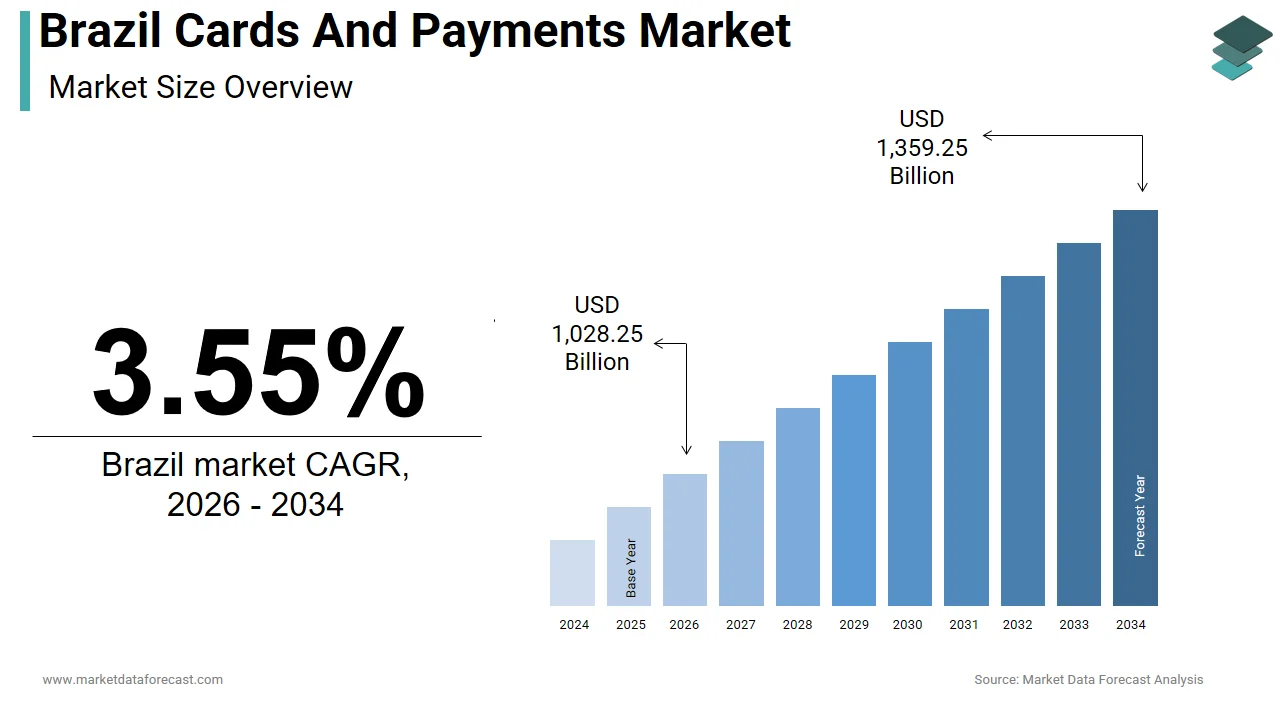
- Market Valuation: Valued at USD 993 billion in 2025, estimated at USD 1,028.25 billion in 2026, and projected to reach USD 1,359.25 billion by 2034, registering a steady CAGR of 3.55% from 2026 to 2034.
- Primary Growth Drivers: Proliferation of digital-only banks (e.g., Nubank, Neon); rising integration of mobile wallets (Apple Pay, Google Pay, Samsung Pay); transition toward contactless/EMV payments and e-commerce expansion.
Key Market Segment Metrics (2026–2034)
| Category | Leading Segment / Position | Segment Details / Breakdown |
|---|---|---|
| By Cards | Debit & Credit Cards | Covers Debit Cards, Credit Cards (with revolving balance regulations), and Prepaid Cards driving financial inclusion. |
| By Payment Terminals | POS Terminals & ATMs | Strong merchant acquisition growth and adoption of EMV/contactless POS terminals across retail networks. |
| By Payment Instruments | Payment Cards & Credit Transfers | Includes Credit Transfers, Direct Debit, Cheques, and Payment Cards, shifting rapidly toward electronic solutions. |
Major Market Players & Market Structure
Market Structure: Highly competitive landscape dominated by major domestic banking institutions and expanding fintech/digital-only platforms, influenced by Central Bank regulatory caps on interchange fees.
Key Companies: Banco Bradesco, Caixa Econômica Federal, Banco Santander, Itaú Unibanco, Banco do Brasil, HSBC, and Citibank.
 Download Free Sample Report
Brazil Cards And Payments Market Size
The Brazil cards and payments market was valued at USD 993 billion in 2025. The market is estimated at USD 1,028.25 billion in 2026 and is projected to reach USD 1,359.25 billion by 2034, growing at a CAGR of 3.55% from 2026 to 2034.
"Brazil Cards and Payments Market" report offers a distinct range of possibilities in the market of payment cards along with the accurately validated statistics of operational cards in the market and their total transactional values. It suggests profitable marketing strategies considering the competitive landscape in the market, purchase trends, payment options in online trade and significant government frameworks impacting the overall payment card market of Brazil.
Our report kindles the hidden opportunities with dependable information about different types of cash transactions, volumes of cardholders, market proportion, current accounts, increase within the number of cards, credit cards outstanding balances, transactional values, details of the issuers at the side of available banking schemes and futuristic analysis of overall cards and payment marketplace in Brazil.
Brazil Cards And Payments Market - Highlights
A deep insight into the total number of cards in circulation, the total number of transactions, average transactional values and other areas involving the use of payment cards. Most common application areas of both debit cards and pay later card.
The trends in the e-commerce industry, card penetration in the market, merchant acquisitions, and the advent of mobile and electronic wallets. The transition towards EMVs and contactless card payments at POS terminals.
New measures introduced by the National Monetary Council (NMC) to propel the use of Credit cards like reduced interest rates and fees. The introduction of rules to restrict the revolving credit lines of card issuers, which offers the cardholders to pay their debt in installments with lower interest rate if they fail to clear it in first 30 days of revolving credit pattern.
The increased use of alternative payments like Google's Android Pay, Samsung's Samsung Pay, supported by banks like Caixa Econômica Federal (CEF), Banco do Brasil, Brasil Pré-Pagos, Porto Seguro, and Banco Santander Brasil, alongside card providers' payment options like Visa Checkout and MasterCard's Masterpass.
Accelerating growth of digital-only banks like Nubank, the first mobile-only bank in Brazil supporting transactions through customers' phones, and Neon, introduced by Contro.ly in 2018 performs all its operations on mobile using the biometric authentication of user face recognition provided by them in the form of selfie during their registration.
KEY MARKET PLAYERS
The major players in the Brazil cards and payments market include
- Banco Bradesco
- Caixa Econômica Federal
- Banco Santander
- Itaú Unibanco
- Banco do Brasil
- HSBC
- Citibank
BRAZIL CARDS AND PAYMENTS MARKET NEWS
- In March 2018, the central bank of Brazil, Banco Central do Brasil, has introduced a cap on interchange fees of debit cards, encouraging the card payments of the users. This cap has been started from October 1, 2018, where the limit is 0.8% of the transaction value with the average below 0.5%. Furthermore, the central bank is also having future plans like decreasing the cap on maximum debit card transaction value and imposing a cap on interchange fees of credit cards.
- International merchant acquires are increasing their focus on the cards and payments market of Brazil. For instance, in July 2018, to introduce acquiring services in the country, Banco Rendimento has collaborated with Worldpay. This collaboration provides e-commerce merchants with payment services, including the payment acquiring, factoring and settlement of various currencies via credit and debit cards. Due to this partnership, the international merchants can now easily accept user payments in Brazil, who are now having around 300 payment methods and 126 currency options.
- The advent of various international payment services has augmented the market for alternative payments in Brazil. Apple Inc. introduced its Apple Pay service in Brazil with the aid of Itaú Unibanco in April 2018, allowing consumers to save the details of their details for any future transactions. Apple Pay, starting from July 2018, is being accepted by Bradesco and Banco do Brasil. Similarly, Google introduced its Android Pay solution in November 2018, and Samsung launched its Samsung Pay in July 2016. Visa Checkout, Paysafecard and Masterpass are other available alternative payments in Brazil.
MARKET SEGMENTATION
This research report on the Brazil cards and payments market has been segmented and sub-segmented based on the following categories.
By Cards
- Debit Cards
- Credit Cards
- Prepaid Cards
By Payment Terminals
- POS
- ATM's
By Payment Instruments
- Credit Transfers
- Direct Debit
- Cheques
- Payment Cards