Global Battery Powered Lawn Mowers Market Size, Share, Trends & Growth Forecast Report, Segmented By Product (Manual, Electric, Petrol, Robotic, Others), End-use (Commercial, Residential) And Region (North America, Europe, Aisa-Pacific, Latin America, Middle East And Africa), Industry Analysis From 2026 to 2034
Market Size, 2025
$17.08 BnMarket Estimate, 2026
$18.10 BnMarket Forecast, 2034
$28.86 BnCAGR, 2026–2034
6%Global Battery-Powered Lawn Mowers Market Size
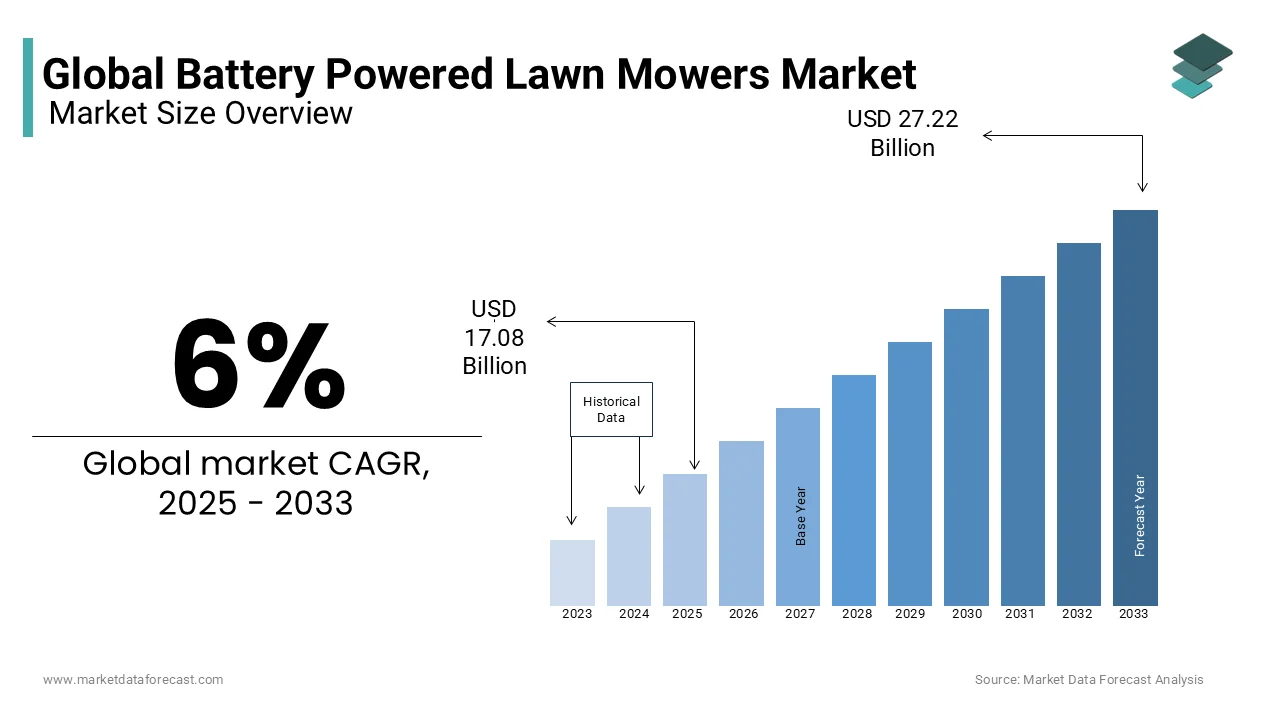
The global battery-powered lawnmowers market was valued at USD 17.08 billion in 2025 and is anticipated to reach USD 18.10 billion in 2026 from USD 28.86 billion by 2034, growing at a CAGR of 6% during the forecast period from 2026 to 2034.
Current Intro And Definition
Battery Powered Lawn Mowers are electric grass cutting equipment that operates using rechargeable lithium ion or alternative battery technologies instead of internal combustion engines. These devices represent a critical segment within the broader outdoor power equipment industry, shaped by technological advancement and shifting consumer priorities toward sustainable garden maintenance. According to World Bank data, urban population in the European Union reached 75.95% in 2024, creating spatial constraints that favor compact and quiet lawn care solutions. As per World Health Organization guidelines, reducing noise levels produced by road traffic to an average exposure below 53 decibels minimizes adverse cardiovascular effects, while aircraft noise must be kept below 45 decibels to protect against cognitive health effects in children. Eurostat analysis reveals that 39.2% of the EU population lived in cities in 2021, intensifying demand for low noise outdoor equipment in densely populated areas. The European Commission has identified noise as a pressing problem in urban areas across Europe, prompting regulatory frameworks that influence equipment design and adoption patterns. Battery powered lawn mowers align with these public health objectives by eliminating localized emissions and noise, thereby supporting the overarching European Green Deal target of complete climate neutrality by 2050. These contextual factors collectively define the operational environment where product development must balance performance expectations with environmental compliance and user well being considerations.
MARKET DRIVERS
Regulatory pressure on noise emissions driving equipment substitution
Environmental legislation across European jurisdictions is increasingly restricting acoustic output from outdoor power equipment, which is driving the growth of the battery powered lawn mowers market. This is creating powerful demand momentum for battery-powered alternatives. According to the European Commission, the Outdoor Noise Directive 2000 slash 14 slash EC regulates noise emissions into the environment by outdoor equipment including lawn mowers, with updated measurement methods applying from 22 May 2025 to enable new limit setting. As per World Health Organization recommendations, average long-term noise exposure should remain below 53 decibels for road traffic to minimize cardiovascular risks—a public health baseline that increasingly guides municipal frameworks targeting neighborhood noise, including garden equipment. Battery-powered lawn mowers typically operate between 75 and 85 decibels at the source, substantially below the regulatory limits enforced under the Outdoor Noise Directive, thereby minimizing localized noise pollution. The Zero Pollution Action Plan targets a 30% reduction in the share of people chronically disturbed by transport noise by 2030; reducing community acoustic pollution from garden equipment logically helps support these broader urban quiet-zone objectives. Municipalities including Paris and Berlin have implemented localized restrictions on high noise outdoor tools during evening hours, creating operational advantages for quieter battery powered units. According to European Union policy documents, noise constitutes the second largest environmental cause of health problems, with more than 22 million people suffering chronic high annoyance from prolonged exposure. These regulatory dynamics create sustained demand growth as commercial landscaping firms and residential consumers proactively replace non compliant equipment to avoid penalties and ensure operational continuity in noise sensitive urban environments.
Urbanization trends favoring compact and low maintenance equipment
Demographic shifts toward city living are reshaping residential garden characteristics and equipment preferences across European landscapes, and this is also propelling the battery-powered lawn mower market forward. According to World Bank collection data, urban population in the European Union reached 75.95% in 2024, concentrating residential density and reducing average garden sizes. Battery powered lawn mowers offer weight advantages averaging 15 to 25 kilograms versus 30 to 45 kilograms for petrol equivalents, facilitating storage in compact sheds and maneuverability in confined spaces. The average residential electricity price in the EU remained stable at 28.72 euros per 100 kilowatt hours in the first half of 2025, providing predictable operating costs for battery charging versus volatile petrol prices. According to survey data from Galaxus, three out of four people in Europe engage in gardening work, with half spending more than two hours weekly on lawn maintenance activities. Battery powered equipment eliminates fuel storage requirements and reduces maintenance tasks by approximately 60% compared to combustion engines, aligning with time constrained urban lifestyles. These demographic and behavioural factors create structural demand growth as urban residents prioritize convenience, space efficiency, and predictable operating expenses in their garden equipment selections.
MARKET RESTRAINTS
Battery performance limitations in variable weather conditions
Lithium ion battery technology faces operational constraints under extreme temperature and moisture conditions that affect equipment reliability and user satisfaction, and thereby restrains the growth of the battery powered lawn mowers market. According to technical assessments, lithium-ion battery capacity can decline by 20% to 30% when ambient temperatures drop below freezing to around minus 10 degrees Celsius, though milder single-digit temperatures in early spring and late autumn still cause minor efficiency losses. Battery powered lawn mowers typically deliver 30 to 60 minutes of continuous operation under optimal conditions, which may prove insufficient for properties exceeding 500 square meters without battery swapping or recharging interruptions. European climate patterns feature significant seasonal variation, with average winter temperatures ranging from minus 5 degrees Celsius in northern regions to 15 degrees Celsius in southern areas, creating inconsistent performance expectations across markets. According to battery technology research, cycle life for consumer grade lithium ion packs averages 500 to 1000 charge cycles before capacity degradation becomes noticeable, translating to approximately 3 to 5 years of seasonal usage. Moisture exposure during damp grass cutting can trigger protective shutdowns in some battery management systems, interrupting workflow and frustrating users accustomed to petrol equipment reliability. These technical limitations create adoption hesitation among consumers with larger properties or those operating in climates with frequent temperature fluctuations, moderating market penetration rates despite growing environmental awareness and regulatory support for electric alternatives.
Charging infrastructure accessibility in residential settings
The practicality of these lawn mowers depends on convenient access to electrical outlets for recharging, a constraint that varies significantly across European housing stock and hampers the growth of the battery powered lawn mowers market. According to Eurostat housing data, approximately 46% of EU residents live in flats or multi-unit dwellings, which often lack dedicated ground-floor garden storage or external power access, complicating charging logistics. As per European residential electricity statistics, the average household electricity price reached 28.72 euros per 100 kilowatt hours in the first half of 2025, with significant variation from 6.2 euros in Turkey to 38.4 euros in Germany affecting operating cost perceptions. Battery powered lawn mowers typically require 60 to 90 minutes for full recharging, creating scheduling constraints for users who prefer spontaneous garden maintenance. According to urban planning assessments, newer residential developments increasingly incorporate external power outlets, but legacy housing stock built before 2000 often lacks this infrastructure, particularly in southern and eastern European markets. The requirement for indoor charging also raises safety considerations regarding battery storage and ventilation, adding complexity to user adoption decisions. These infrastructure limitations create friction in the customer journey from purchase consideration to regular usage, particularly among apartment dwellers and owners of older properties, moderating market growth despite favorable environmental attributes and regulatory tailwinds supporting electric outdoor equipment adoption.
MARKET OPPORTUNITIES
Integration with renewable energy and smart home ecosystems
The convergence of these lawn mowers with residential solar generation and home energy management systems offers substantial growth potential for manufacturers investing in interoperability and software development, which is likely to promote the growth of the battery powered lawn mowers market. According to European electricity price statistics, residential rates averaged 28.72 euros per 100 kilowatt hours in the first half of 2025, creating economic incentives for aligning equipment charging with off peak periods or self generated solar power. As per smart home landscape analysis, the European smart home market continues to experience steady double-digit growth, driven by growing consumer demand for convenience, home security, and real-time energy monitoring to manage volatile grid prices. Battery powered lawn mowers equipped with scheduling capabilities can optimize charging during low cost electricity windows or when rooftop solar generation exceeds household demand, enhancing total cost of ownership advantages. According to European Commission policy frameworks, the Energy Performance of Buildings Directive encourages the integration of renewable energy and smart controls in residential properties, fostering a broader consumer ecosystem that favors energy-efficient home and landscaping utilities. Manufacturers offering application based control, weather adaptive scheduling, and energy usage analytics can differentiate products and command premium pricing in markets where digital home management adoption accelerates. These technological synergies create opportunities for value added services, subscription based maintenance alerts, and ecosystem lock in that extend beyond initial equipment sales to generate recurring revenue streams and enhanced customer retention in the evolving outdoor power equipment landscape.
Expansion into commercial landscaping and municipal maintenance contracts
Professional landscaping firms and municipal authorities are high volume adoption segments, where operational efficiency and regulatory compliance drive equipment procurement decisions, which is expected to fuel the expansion of the battery powered lawn mowers market. According to European occupational safety guidance, the Physical Agents Vibration Directive sets a daily exposure action value of 2.5 meters per second squared for hand-arm vibration, an action threshold that battery-powered equipment can more readily stay below compared to petrol alternatives. As per municipal procurement trends, public authorities increasingly evaluate whole lifecycle costs including emissions compliance, noise restrictions, and operator health impacts when selecting outdoor maintenance equipment. Battery powered lawn mowers eliminate fuel handling requirements and reduce maintenance tasks by approximately 60% compared to combustion engines, lowering total cost of ownership for commercial users managing equipment fleets. According to European Green Deal objectives, transport-related greenhouse gas emissions must decline by 90% by 2050; while this legally targets the transport sector, it fuels a broader electrification momentum across all localized mobile machinery, including garden tools. Manufacturers developing commercial grade battery systems with rapid swap capabilities, fleet management software, and service network support can capture growing demand from professional users seeking to meet environmental targets while maintaining operational productivity. These commercial applications offer higher average selling prices, longer contract durations, and stronger brand loyalty compared to residential segments, creating attractive growth avenues for manufacturers willing to invest in professional product development and distribution channels.
MARKET CHALLENGES
Supply chain vulnerability for critical battery materials
The production of lithium ion batteries depends on geographically concentrated sources of raw materials including lithium, cobalt, and nickel, creating supply chain risks that affect equipment availability and pricing stability, and therefore challenges the growth of the battery powered lawn mowers market. According to European Commission assessments, the EU imports more than 90% of its lithium and cobalt requirements, primarily from Australia, Chile, and the Democratic Republic of Congo, exposing manufacturers to geopolitical and logistical disruptions. As per battery industry analysis, lithium prices experienced volatility exceeding 300% between 2021 and 2023 due to surging electric vehicle demand and constrained mining capacity, creating cost uncertainty for lawn mower manufacturers reliant on similar battery chemistries. The EU Battery Regulation establishes rigorous new due diligence requirements for critical raw materials, though the European Council has officially postponed enforcement of these specific obligations until August 18, 2027, to ease initial administrative complexity for producers. According to European industrial policy documents, establishing domestic battery material processing capacity represents a strategic priority but requires substantial capital investment and multi year development timelines. These supply chain dynamics create pricing pressure and production planning challenges for battery powered lawn mower manufacturers, particularly smaller firms lacking the scale to secure long term material contracts or absorb cost fluctuations, potentially moderating market growth and consolidation pressures across the competitive landscape.
Consumer education gaps regarding total cost of ownership
Many residential buyers evaluate lawn mower purchases based primarily on initial price rather than long term operating expenses, which inhibits the expansion of the battery powered lawn mowers market. This creates adoption barriers for battery powered equipment despite favorable lifecycle economics. According to European consumer behavior research, approximately 60% of residential equipment buyers prioritize upfront cost over maintenance requirements or energy expenses when making purchase decisions. As per professional grade battery powered mower systems including spare batteries and chargers may exceed 1000 euros, whereas functionally equivalent petrol models often retail below 800 euros, creating a visible price differential that influences budget constrained consumers. Battery powered equipment delivers lower operating costs through eliminated fuel purchases and reduced maintenance, yet the payback period typically extends beyond two years of regular use, a timeframe that exceeds the planning horizon for many residential buyers. According to European procurement guidance, public authorities are encouraged to evaluate whole lifecycle costs, yet private consumers frequently lack analytical tools or financial flexibility to adopt this perspective. Manufacturers investing in consumer education regarding total cost of ownership, battery longevity, and environmental benefits can improve conversion rates, but require sustained marketing expenditure and channel partner training to overcome entrenched purchasing habits and price sensitivity in competitive retail environments.
REPORT COVERAGE
| REPORT METRIC | DETAILS |
| Market Size Available | 2025 to 2034 |
| Base Year | 2025 |
| Forecast Period | 2026 to 2034 |
| CAGR | 6% |
| Segments Covered | By Product, End-Use, and Region. |
| Various Analyses Covered | Global, Regional, and Country Level Analysis, Segment-Level Analysis, DROC, PESTLE Analysis, Porter’s Five Forces Analysis, Competitive Landscape, Analyst Overview of Investment Opportunities |
| Regions Covered | North America, Europe, APAC, Latin America, Middle East & Africa |
| Market Leaders Profiled | American Honda Motor Co. Inc. (Honda Power Equipment), Ariens Company, Deere & Company (Agriculture & Turf), Falcon Garden Tools Pvt. Ltd., Husqvarna Group, Robert Bosch GmbH (Bosch Power Tools), Robomow (Friendly Robotics), The Toro Company, and Others. |
SEGMENTAL ANALYSIS
By Product Segment Analysis
The electric cordless walk behind segment maintained dominance by accounting for a 54.3% share of the global market in 2025. This dominance of the segment was driven by its optimal balance of affordability, performance, and compatibility with existing battery ecosystems. According to European Garden Monitor data, 58% of Swedish homeowners and 47% of German homeowners prefer lightweight equipment under 25 kilograms for ease of storage and maneuverability, attributes inherent to electric walk behind designs. As per retail distribution analysis, major home improvement chains allocate 65% of lawn mower shelf space to electric cordless models, reinforcing consumer visibility and purchase accessibility. According to product innovation pipelines, manufacturers prioritize 40 volt to 80 volt battery architectures for walk behind units, enabling cross compatibility with trimmers, blowers and hedge cutters within single brand ecosystems. These converging factors of practical performance, ecosystem integration and retail prioritization sustain the dominance of electric cordless walk behind mowers across global residential markets.
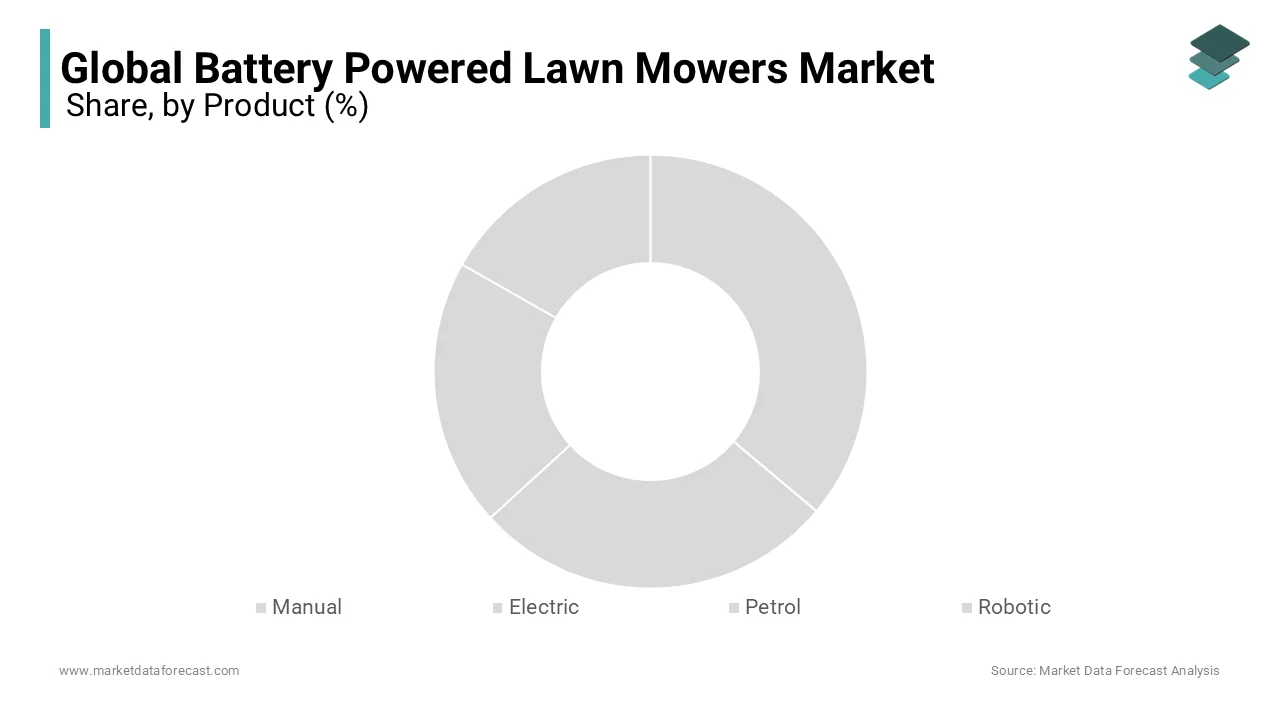
On the other hand, the robotic lawn mowers segment is predicted to witness the highest CAGR of 14.8% from 2026 to 2034 due to advancing automation technologies, declining sensor costs, and rising consumer demand for time saving garden solutions. As per European technology adoption studies, 23% of urban homeowners in Germany and 19% in the Netherlands express willingness to invest in autonomous garden equipment, creating a receptive early adopter base. According to product performance benchmarks, contemporary robotic mowers navigate complex lawn geometries using GPS boundary mapping and obstacle detection sensors with 98.5% operational reliability under standard conditions. According to manufacturer development roadmaps, integration with smart home platforms enables weather adaptive scheduling, remote start commands and maintenance alerts via mobile applications, enhancing user convenience. These technological advancements combined with evolving consumer expectations for automated home maintenance establish robotic lawn mowers as the highest growth opportunity within the battery powered segment.
By End Use Segment Analysis
The residential segment led the battery powered lawn mowers market and captured a significant share in 2025. This leading position of the segment was attributed to the prevalence of single family homes with private garden spaces across developed economies and increasing consumer preference for quiet, emission free equipment. According to Eurostat housing statistics, approximately 54% of the European Union population resides in detached or semi-detached properties, establishing a substantial addressable consumer base with private outdoor areas. As per residential purchasing trends, a growing majority of homeowners value low-noise operation and zero emissions, but functional metrics such as cutting performance and upfront cost remain the primary deciders when selecting lawn care equipment. As per retail channel analysis, online and big box home improvement retailers allocate over 80% of battery mower inventory to residential specification models, reflecting demand concentration. According to demographic trend analyses, aging populations in North America and Europe increasingly seek lightweight, easy start equipment that reduces physical strain during garden maintenance. These structural factors of housing patterns, consumer preferences and retail alignment sustain the residential segment's overwhelming market share position.
But the commercial segment is estimated to register the fastest CAGR of 12.3% during the forecast period owing to municipal noise ordinances, corporate sustainability mandates, and total cost of ownership advantages for professional landscaping operations. According to International Facility Management Association benchmarks, commercial landscaping contracts increasingly specify zero emission equipment to comply with urban environmental regulations and corporate ESG commitments. As per regional public peace ordinances, hundreds of individual municipalities across Germany, France, and the Netherlands enforce strict morning, lunch, and evening quiet windows for gardening tasks, creating an indirect preference for quieter battery alternatives over petrol gear. According to fleet management studies, battery powered commercial mowers reduce annual maintenance expenses by 35% compared to petrol equivalents through elimination of oil changes, filter replacements and spark plug servicing. As per operator productivity analyses, modern lithium ion battery systems with swappable packs enable continuous 6 hour shifts with minimal downtime, meeting professional service level requirements. According to municipal procurement reports, cities including Copenhagen, Amsterdam and Barcelona have transitioned 60% of public grounds maintenance fleets to battery powered equipment since 2022. These regulatory, economic and operational drivers establish the commercial segment as the highest growth end use category within the battery powered lawn mower market.
REGIONAL MARKET ANALYSIS
North America Market Analysis
North America was the top performer in the global market and occupied a 38.7% share in 2025. The demand for these lawn mowers in the region was credited to high residential lawn ownership rates, strong consumer purchasing power, and early adoption of cordless outdoor power equipment. According to United States Census Bureau housing data, the median residential plot size sits between 780 and 930 square meters, providing a substantial footprint where structural lawn and yard maintenance solutions remain in steady demand. Battery powered lawn mower unit sales in the United States grew by 28% year over year in 2024, reflecting accelerating consumer transition from petrol platforms. According to Home Depot and Lowe's retail disclosures, cordless lawn equipment now represents 72% of new mower inventory across North American stores, indicating strong channel commitment to battery technology. As per industry association surveys, 54% of professional landscaping firms in Canada and the United States have incorporated at least one battery powered mower into their fleets to comply with local noise ordinances and client sustainability preferences. According to energy cost analyses, residential electricity rates averaging 0.16 US dollars per kilowatt hour in North America make battery mower operation 85% less expensive per season than petrol equivalents. These structural advantages of lawn culture, retail alignment and operational economics sustain North America's dominant regional position.

Europe Market Analysis
Europe was the second largest player in the global market and occupied a 31.2% share in 2025. This growth of the European market was driven by stringent environmental regulations, high urbanization density, and strong consumer commitment to sustainable living practices. According to European Commission policy frameworks, the Zero Pollution Action Plan targets significant noise reduction in residential areas by 2030, creating regulatory momentum for quiet battery powered garden equipment. As per Eurostat urbanization statistics, 75% of European residents live in urban or suburban settings where compact, emission free lawn care solutions align with spatial constraints and community expectations. As per retail distribution analyses, major European home improvement chains allocate over 68% of lawn mower floor space to battery powered models, reinforcing consumer access and brand visibility. According to municipal procurement data, cities including Berlin, Paris and Amsterdam have implemented preferential purchasing policies for zero emission grounds maintenance equipment, stimulating commercial segment demand. These converging policy, demographic and commercial factors establish Europe as a high value, regulation driven market for battery powered lawn mowers.
Asia Pacific Market Analysis
Asia Pacific plays a key role in the global market due to rising urban middle class populations, increasing residential garden ownership in developed economies, and growing environmental awareness across the region. According to United Nations urbanization reports, 52% of Asia Pacific residents now live in urban areas, creating demand for compact, low noise lawn care solutions suitable for smaller residential plots. As per Japan Garden Association surveys, 41% of Japanese homeowners with garden spaces under 300 square meters prefer lightweight battery powered mowers for ease of storage and maneuverability. As per Chinese consumer studies, 29% of urban homeowners in tier one cities express willingness to invest in premium cordless garden tools, indicating emerging premium segment demand. According to regional manufacturing analyses, local production of lithium ion batteries in South Korea, Japan and China reduces equipment costs and accelerates product availability across Asia Pacific markets. These demographic, economic and supply chain dynamics position Asia Pacific for sustained expansion in battery powered lawn mower adoption.
Latin America Market Analysis
Latin America is moving ahead steadfastly in the global market owing to growing urbanization, increasing middle class disposable income, and gradual adoption of cordless outdoor power equipment in major metropolitan areas. According to World Bank urban development data, 81% of Latin American residents live in urban settings, creating demand for compact, low maintenance lawn care solutions suitable for smaller residential plots. According to Mexican consumer surveys, 38% of homeowners in Mexico City and Monterrey prioritize emission free garden equipment to comply with local air quality initiatives. As per regional distribution assessments, major home improvement retailers in Chile, Colombia and Argentina have expanded battery powered lawn equipment assortments by 45% since 2023, improving product accessibility. According to economic development reports, rising disposable income among urban middle class households in Latin America enables gradual transition from manual to battery powered lawn care tools. These urbanization, retail and economic factors establish Latin America as an emerging growth market for battery powered lawn mowers.
Middle East and Africa Market Analysis
The Middle East and Africa region maintains a modest market position due to selective adoption in high income residential communities, luxury hospitality properties, and expatriate neighborhoods. According to Gulf Cooperation Council urban development reports, premium residential compounds in United Arab Emirates, Saudi Arabia and Qatar increasingly specify battery powered garden equipment to align with sustainability certifications and noise reduction requirements. According to hospitality industry benchmarks, luxury hotels and resorts across the region prefer quiet, emission free lawn maintenance equipment to enhance guest experience and comply with environmental management standards. As per regional import analyses, availability of battery powered lawn mowers remains limited outside major urban centers due to distribution challenges and price sensitivity among broader consumer segments. According to climate adaptation studies, water conservation priorities in arid regions favor smaller lawn areas that align with the operational capacity of battery powered equipment. These niche adoption patterns establish Middle East and Africa as a specialized, high value market segment with long term growth potential.
COMPETITIVE LANDSCAPE
The battery powered lawn mowers market features intense competition among established outdoor power equipment manufacturers, emerging technology focused entrants and private label retailers. Incumbent brands leverage decades of engineering expertise, distribution networks and brand recognition to defend market position while investing in battery technology transitions. New entrants differentiate through innovative robotic capabilities, smart home integration and direct to consumer business models that bypass traditional retail channels. Price competition remains significant in entry level segments while premium tiers emphasize performance, durability and ecosystem compatibility as key purchase criteria. Geographic competition varies with European markets favoring robotic and ultra quiet designs, North American consumers prioritizing power and runtime, and emerging regions focusing on affordability and basic functionality. Intellectual property disputes regarding battery management systems, navigation algorithms and motor designs create additional competitive complexity. The convergence of technological innovation, regulatory pressure and evolving consumer preferences ensures dynamic competitive evolution as participants vie for leadership in this rapidly expanding market category.
KEY MARKET PLAYERS
The Major players in the global battery-powered lawn mowers market are
- American Honda Motor Co., Inc. (Honda Power Equipment)
- Ariens Company
- Stanley Black and Decker
- Yamaha Motor Corporation
- Deere & Company (Agriculture & Turf)
- Falcon Garden Tools Pvt. Ltd.
- Husqvarna Group
- Robert Bosch GmbH (Bosch Power Tools)
- Robomow (Friendly Robotics)
- The Toro Company
Top Market Players
- Husqvarna Group maintains a prominent position in the battery powered lawn mowers market through its comprehensive Automower robotic series and cordless walk behind platforms. The company leverages decades of outdoor power equipment expertise to deliver innovative battery architectures, smart connectivity features and durable construction. Recent strategic actions include expansion of its 40 volt battery ecosystem across multiple product categories, enabling cross compatibility that enhances customer value. Husqvarna has invested in artificial intelligence driven navigation systems for robotic mowers, improving obstacle detection and cutting efficiency. The company also strengthened its direct to consumer digital channels and professional dealer networks to improve market accessibility. Through sustainability commitments including carbon neutral manufacturing targets and battery recycling programs, Husqvarna aligns with evolving European and North American environmental expectations. These product innovation, ecosystem development and sustainability initiatives reinforce Husqvarna's competitive positioning in the global battery powered lawn mower landscape.
- Stanley Black and Decker participates actively in the battery powered lawn mowers market through its Greenworks and CRAFTSMAN brand portfolios, targeting both residential and professional segments. The company leverages its extensive battery platform technology, originally developed for power tools, to deliver high performance cordless lawn equipment with cross category compatibility. Recent strategic initiatives include launch of 80 volt maximum battery systems offering extended runtime and power for demanding mowing applications. Stanley Black and Decker has expanded retail partnerships with major home improvement chains across North America and Europe to increase product visibility and accessibility. The company also invested in consumer education campaigns highlighting total cost of ownership advantages of battery powered equipment versus petrol alternatives. Stanley Black & Decker strengthens its value proposition for time-conscious and environmentally aware consumers seeking reliable lawn care solutions. They achieve this through continuous innovation in battery management systems, motor efficiency, and ergonomic design.
- Yamaha Motor Corporation brings engineering excellence and brand reputation to the battery powered lawn mowers market through its focus on premium residential and commercial applications. The company leverages its expertise in electric drive systems and precision manufacturing to deliver quiet, durable and high performance cordless mowers. Recent strategic actions include development of proprietary lithium ion battery technology optimized for outdoor power equipment cycles and temperature resilience. Yamaha has expanded its distribution network through specialized landscaping dealers and premium retail channels to reach discerning customers. The company also integrated smart connectivity features enabling app based scheduling, maintenance alerts and performance monitoring for enhanced user experience. Through commitments to quality, reliability and after sales support, Yamaha differentiates its battery powered lawn mower offerings in competitive premium segments. These product development, channel expansion and customer experience initiatives reinforce Yamaha's positioning as a technology focused participant in the evolving battery powered outdoor equipment market.
Top Strategies Used By Key Market Participants
Key participants in the battery powered lawn mowers market prioritize battery platform standardization to enable cross category tool compatibility and increase customer ecosystem loyalty. Companies invest heavily in research and development to extend battery runtime, reduce charging duration and improve power density for demanding mowing applications. Strategic retail partnerships with major home improvement chains and online marketplaces enhance product visibility and consumer accessibility across geographic regions. Manufacturers increasingly integrate smart connectivity features including mobile app control, GPS mapping and predictive maintenance alerts to differentiate premium offerings. Sustainability commitments including carbon neutral manufacturing, recyclable packaging and battery take back programs align with evolving regulatory and consumer expectations. Professional segment engagement through specialized dealer networks, fleet demonstration programs and commercial specification products expands addressable market beyond residential users. These converging strategies of ecosystem development, technological innovation, channel expansion, digital integration and sustainability alignment define competitive positioning in the dynamic battery powered lawn mower landscape.
MARKET SEGMENTATION
This market research report on the global battery-powered lawnmowers market is segmented and sub-segmented into the following categories.
By Product
- Manual
- Electric
- Petrol
- Robotic
- Others
By End-Use
- Commercial
- Residential
By Region
- North America
- Europe
- Asia-Pacific
- Middle East and Asia
- Latin America
Frequently Asked Questions
What is the battery powered lawn mowers market?
It’s the market for cordless lawn mowing equipment powered by rechargeable batteries, replacing traditional gas-powered models.
What drives growth in the battery powered lawn mowers market?
Rising demand for eco-friendly outdoor tools, stricter emissions regulations, and improvements in battery technology are key growth factors.
How do battery powered lawn mowers differ from gas mowers?
Battery mowers produce zero direct emissions, operate quietly, require less maintenance, and are easier to start than gas mowers.
What types of batteries are used in these lawn mowers?
Lithium-ion batteries are most common due to high energy density, long life, and fast charging capabilities.
Who are the primary users of battery powered lawn mowers?
Homeowners, professional landscapers, and small-scale commercial users are the main customers.
What advantages do battery lawn mowers offer?
They provide cleaner operation, quieter performance, lower maintenance costs, and reduced fuel dependency.
Are battery powered lawn mowers suitable for large yards?
Yes, advanced battery systems with extended runtime make them increasingly suitable for medium to large lawns.
How long do battery powered lawn mowers run on a single charge?
Runtime typically ranges from 30 to 90+ minutes depending on battery capacity and cutting conditions.
What challenges does the battery powered lawn mower market face?
Battery cost, limited runtime compared to fuel models, and charging infrastructure are common market challenges.
How does technology influence this market?
Improvements in battery life, brushless motors, smart power management, and rapid charging boost performance and adoption.
Related Reports
Access the study in MULTIPLE FORMATS
Purchase options starting from
$ 2500
Didn’t find what you’re looking for?
TALK TO OUR ANALYST TEAM
Need something within your budget?
NO WORRIES! WE GOT YOU COVERED!
Call us on: +1 888 702 9696 (U.S Toll Free)
Write to us: sales@marketdataforecast.com